
Most founding teams begin as peers. Each founder covers a specialty and several other jobs, and the roles are about the same size. Growth changes that. As the company hires specialists, each founder's role narrows, except for the founder who takes the role of CEO. The CEO founder grows in responsibility and becomes more powerful over time.
This asymmetry often creates tension within a founding team and contributes to founders leaving the company. This post describes that pattern, explains why it happens, and suggests what founders can do about it.
What happens as a company grows
Take a team of three: a CEO who knows the field, a technical founder, and an operations founder. At the start each runs a specialty and a few other functions. As the company grows, it hires a specialist for each of those other functions, and each specialist reports to the CEO.
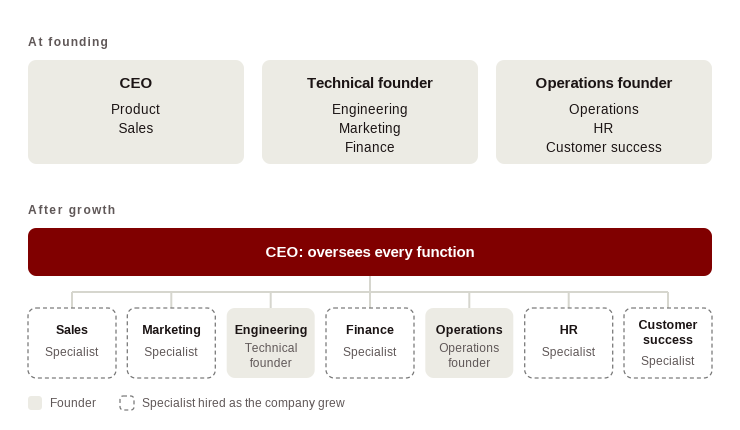
The two other founders end with their specialty. The CEO ends with authority over every function.
Why it happens
Two forces produce the pattern, and neither is anyone's fault.
Specialization. A founder can cover marketing or finance for a company of five. A company of ninety needs someone who does those jobs all day. The founder is not failing. The job has grown past what a person can do on the side, and the company needs a specialist to advance. The founder keeps the specialty, such as engineering, and gives up the rest.
Coordination. Specialists know their own area. Someone has to see across sales, marketing, finance, and product, and that person needs working knowledge of each. That job belongs to the CEO. Economists have described both forces: firms gain from specialization but must then coordinate the specialists, and the person who runs a venture needs balanced skills across many fields.
The CEO also stops doing most of the work. The difference is that the CEO keeps authority over all of it. The other founders give up both the work and the authority.
Why the gap causes tension
Founders judge their roles against each other. At the start the roles are comparable. Equity and titles are set then, and they often do not change. A few years later one founder is involved in every part of the business, and each of the others runs one function.
No single decision causes this. Each hire makes sense on its own. The gap comes from the sum of them, and it can produce tension that contributes to a founding team breaking apart.
What founders can do
Founders cannot prevent the gap, and they should not try. The hires that create it are the hires the company needs. What founders can do is expect it and plan for it.
- Expect it. The roles of the non-CEO founders will narrow as the company hires. The CEO's will not. Both follow from growth and not from anyone's conduct.
- Talk about it at the start. Before the first hire, each founder should say which functions they expect to keep, and what they want their role to be when the company has fifty people.
- Agree on how hiring decisions get made. Decide in advance how the team will choose when to hire for a function a founder covers, and give that founder a part in the hire.
- Keep founders involved beyond their function. A regular meeting of the founders on the whole business preserves some of what a narrower role takes away.
- Revisit roles at set points. A financing round or the first executive hire in a founder's function is a natural time to ask whether roles, pay, and equity still fit.
- Ask your lawyer. Founder documents usually cover vesting and the equity split. They usually say nothing about roles. Counsel can help founders decide whether to write any of this down.
None of this removes the gap. It makes the gap less of a surprise, and a surprise is harder to handle than a plan.
Further reading
Research on founding teams has observed parts of this pattern.
- Mathias & Williams, Giving Up the Hats? Entrepreneurs' Role Transitions and Venture Growth (2018), on how entrepreneurs narrow their roles as ventures grow.
- Van Lancker, Knockaert, Collewaert & Breugst, Preparing for Scaling: A Study on Founder Role Evolution (2023), on new hires taking over parts of founders' roles.
- Brattström, Task Re-allocation in New Venture Teams (2024), on the conflict that follows when teams reassign tasks.
- Breugst, Patzelt & Rathgeber, How Should We Divide the Pie? (2015), on perceived fairness in founding teams.
- Wasserman, The Founder's Dilemmas (2012), on the decisions that divide founding teams.