
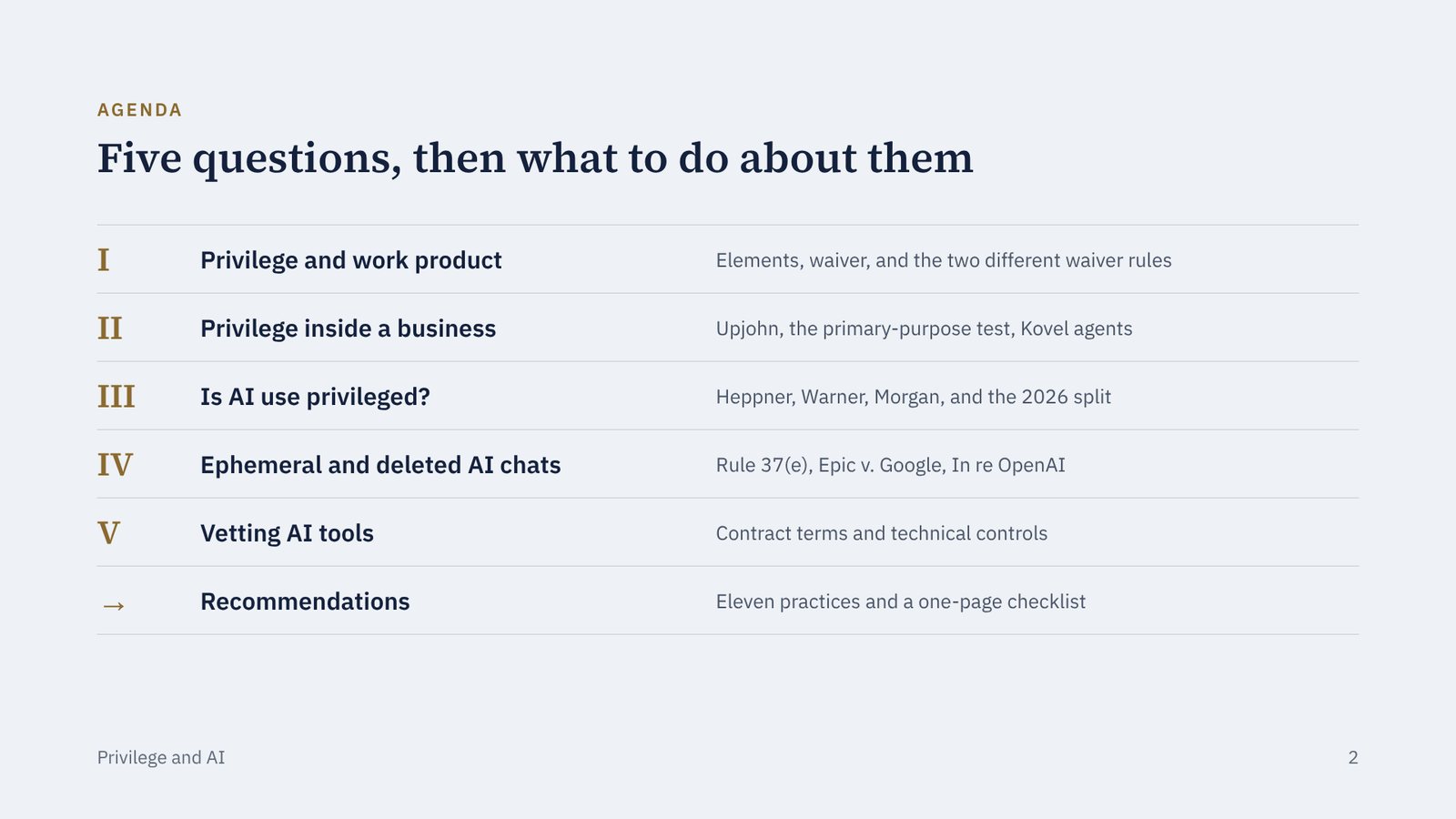
Is AI use privileged? What happens to work product when a lawyer, or a client, runs it through an AI tool? And what happens when AI chats are deleted? Below are the slides and the companion memo from the AI Lab's briefing for general counsel on privilege and AI. The memo has the full analysis, citations, and a checklist.
The law is current through November 9, 2026. This is for education, not advice on any specific matter.
The slides
The memo
Executive Summary
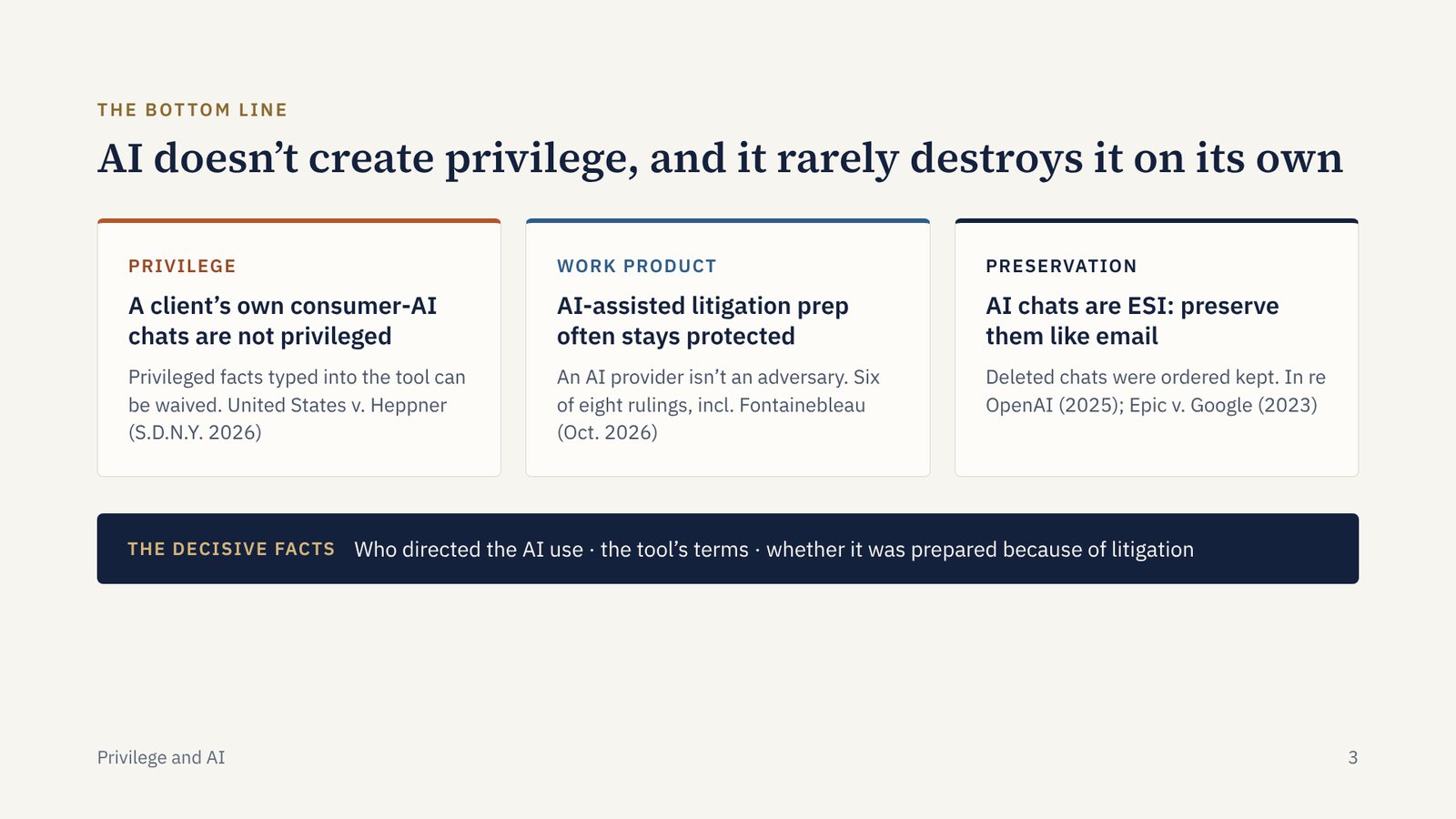
Bottom line: AI use doesn't create privilege, and it rarely destroys it by itself. Courts decide these disputes with existing doctrine. The decisive facts are who directed the AI use, whether the tool kept inputs confidential, and whether the material was prepared because of litigation.
- Privilege and work product are different shields, and AI cases are splitting along that line. Attorney-client privilege generally doesn't survive disclosure to a third party. Work product is waived only by disclosure to an adversary, or in a way that makes reaching an adversary substantially more likely.
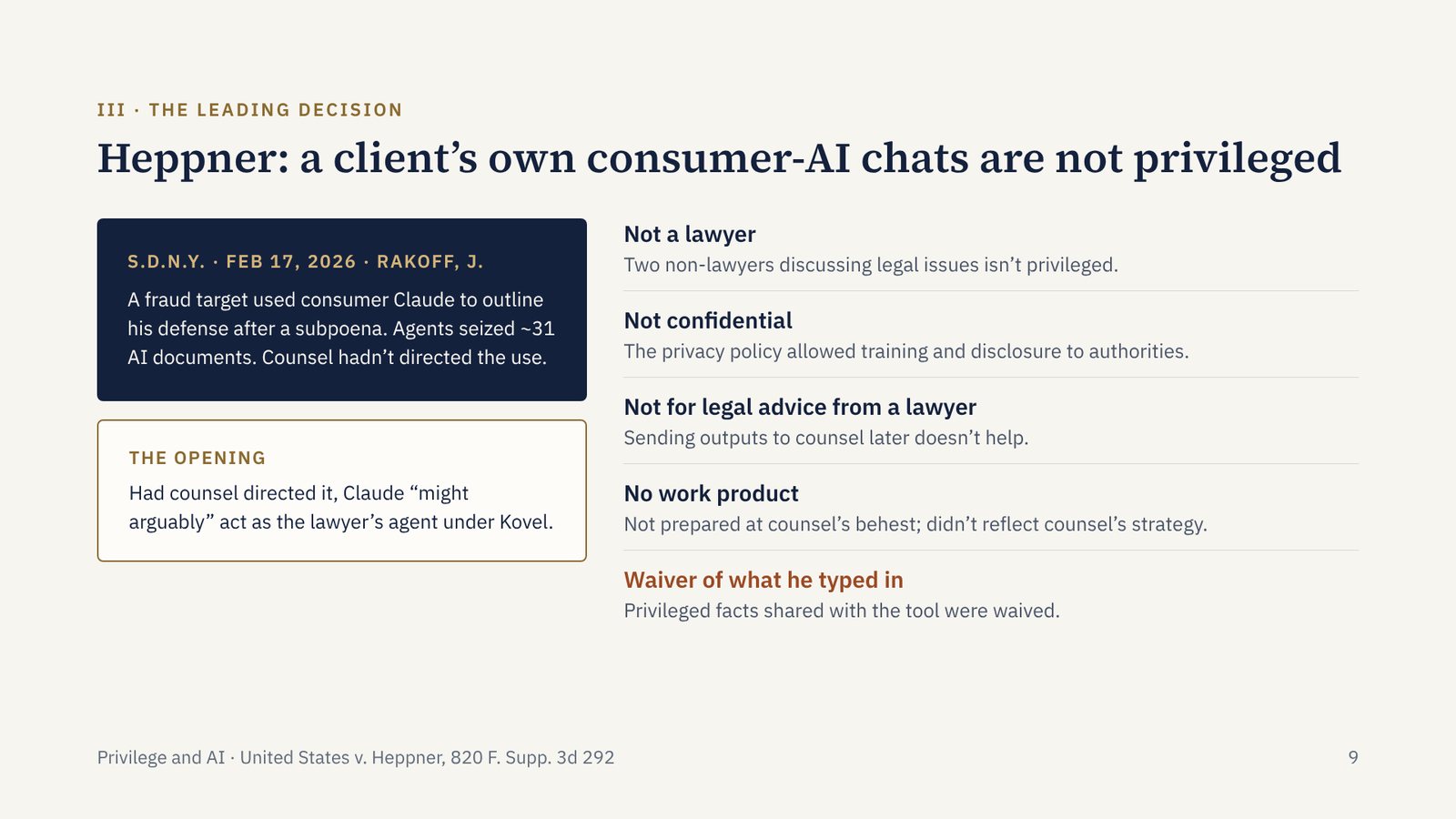
- A client's own consumer-AI chats are not privileged. In United States v. Heppner, 820 F. Supp. 3d 292 (S.D.N.Y. 2026), Judge Rakoff held that a defendant's self-directed Claude chats were neither privileged nor work product. Privileged facts he typed into the tool were also waived.
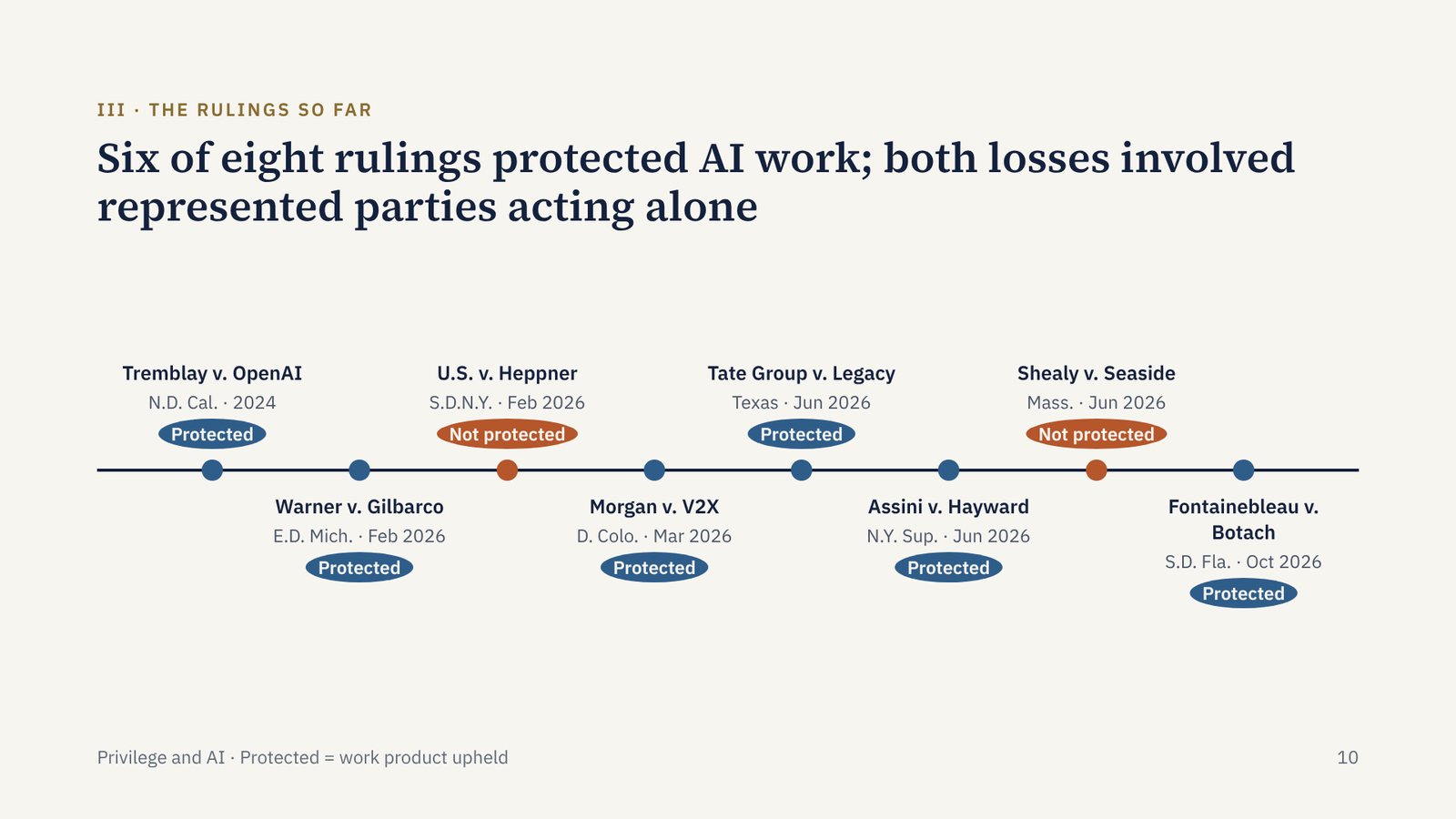
- Work product often survives AI use in civil litigation. Six of the eight AI rulings to date protected AI-assisted work, reasoning that AI is "a tool, not a person" and an AI provider isn't an adversary. The newest, Fontainebleau Florida Hotel, LLC v. Botach (S.D. Fla. Oct. 21, 2026), protected a party's AI chats even without counsel's direction and expressly declined to follow Heppner on that point. But it required a document-by-document showing on a privilege log.
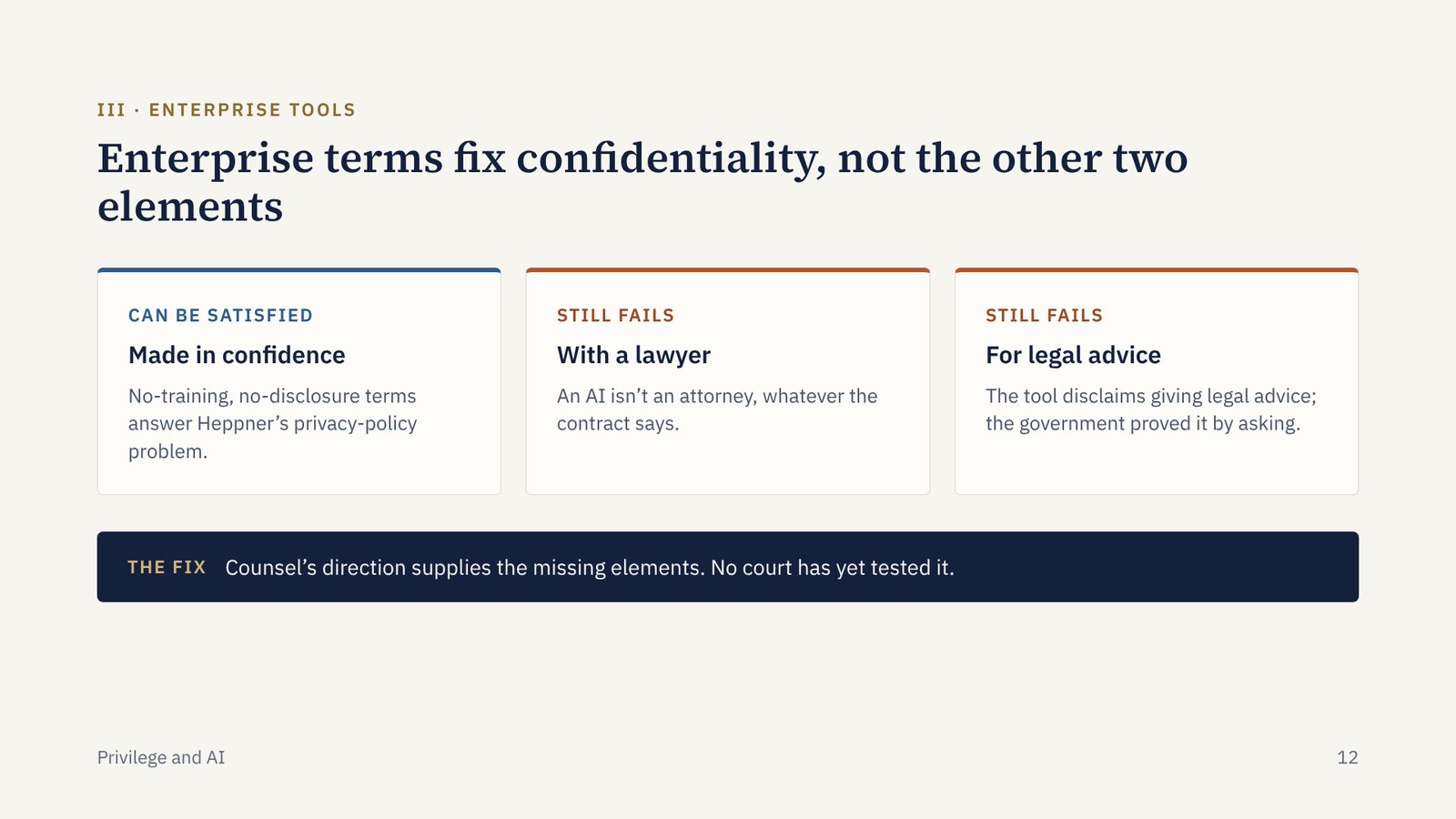
- Enterprise terms are necessary but not sufficient. An enterprise tool with no-training and confidentiality terms can satisfy the confidentiality element. It doesn't make a non-lawyer's chat a communication with a lawyer, or a request for legal advice. Counsel's direction is what supplies those elements, and Heppner left open that counsel-directed AI could fit within the Kovel agent doctrine.
- Inside a company, AI makes old problems bigger. Dual-purpose prompts, auto-distributed AI meeting summaries, AI agents with broad file access, and employees pasting legal advice into personal chatbots all erode privilege. Separately represented executives face a special trap: the company controls its own AI tool, and consumer tools fail Heppner.
- AI prompts and outputs are ESI, and opponents can get them from the vendor. Courts have ordered an AI provider to keep chats users had deleted (In re OpenAI) and sanctioned companies for letting ephemeral chats auto-delete under a hold (Epic v. Google). In Fontainebleau, the plaintiff subpoenaed four AI providers directly.
- Recommended action: adopt a layered AI privilege and retention program now. It should combine approved tools vetted by contract (not just "no training"), counsel-directed workflows for legal work, technical controls that block uploads to unapproved tools, AI-aware holds and retention schedules, outside-counsel and vendor rules, and an incident plan for when privileged material has already leaked.
I. Attorney-Client Privilege and Work Product: The General Framework
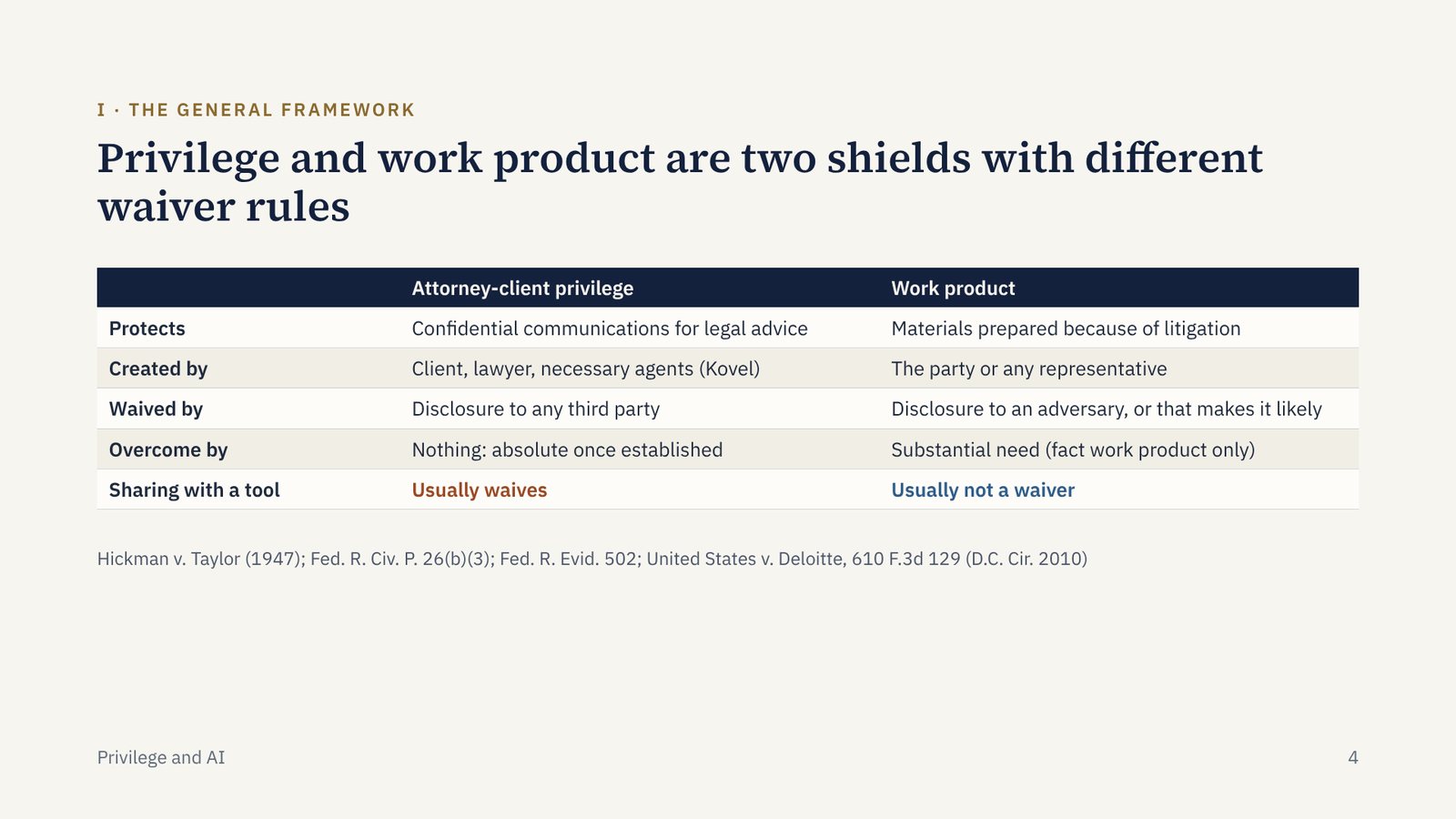
Two doctrines do most of the work, and they protect different things. The attorney-client privilege protects confidential communications made to get legal advice. The work-product doctrine protects materials prepared because of litigation. Most AI disputes are decided by which doctrine applies and how each is waived.
A. Attorney-client privilege
The privilege protects (1) a communication (2) between a client and a lawyer, or their agents, (3) made in confidence (4) for the purpose of getting or giving legal advice. See United States v. Mejia, 655 F.3d 126, 132 (2d Cir. 2011); Fisher v. United States, 425 U.S. 391, 403 (1976). The party claiming privilege bears the burden of proving each element. Courts construe the privilege narrowly because it withholds relevant evidence.
- It protects communications, not facts. A client can't shield an underlying fact by telling it to a lawyer. Upjohn Co. v. United States, 449 U.S. 383, 395–96 (1981).
- Confidentiality is an element, not a formality. A communication made with no reasonable expectation of confidentiality was never privileged. Disclosing it later to a third party outside the privilege usually waives it.
- Agents can sit inside the privilege. Interpreters, accountants, and consultants needed for the lawyer to give advice can keep the privilege intact. United States v. Kovel, 296 F.2d 918, 922 (2d Cir. 1961). The agent must be helping the lawyer give advice, not just giving the client useful information.
- Waiver can spread. An intentional disclosure in a federal proceeding can waive undisclosed material on the same subject when fairness requires it. Fed. R. Evid. 502(a). An inadvertent disclosure doesn't waive privilege if the holder took reasonable steps to prevent it and to fix it promptly. Fed. R. Evid. 502(b). A court order under Rule 502(d) can provide that production in the case is not a waiver anywhere. These are the main tools for limiting fallout from an AI-related disclosure in litigation.
- Exceptions and implied waiver. The privilege doesn't protect communications made to further a crime or fraud. A client who relies on counsel's advice as a defense puts that advice at issue and waives privilege over it. And communications about purely business matters were never privileged. See Neuder v. Battelle Pac. Nw. Nat'l Lab., 194 F.R.D. 289, 293 (D.D.C. 2000).
B. Work product
The doctrine began in Hickman v. Taylor, 329 U.S. 495 (1947), and is codified for civil cases at Fed. R. Civ. P. 26(b)(3). It protects documents and tangible things prepared "in anticipation of litigation or for trial by or for another party or its representative." The rule names an attorney, consultant, insurer, or agent as examples of a representative.
- "In anticipation of litigation." Most circuits ask whether the document was prepared "because of" the prospect of litigation, considering its nature and the factual situation. United States v. Adlman, 134 F.3d 1194, 1202 (2d Cir. 1998). Documents prepared in the ordinary course of business are not protected either way.
- Fact vs. opinion work product. An opponent can get fact work product by showing substantial need and undue hardship. Opinion work product, meaning mental impressions, conclusions, opinions, and legal theories, is nearly absolute. Fed. R. Civ. P. 26(b)(3)(B).
- It belongs to the party, not just the lawyer. The rule covers material prepared by the party itself. Several courts have applied it to pro se litigants, a point that drives the 2026 AI decisions.
C. The distinction that matters most: waiver standards
| Attorney-client privilege | Work product | |
|---|---|---|
| What it protects | Confidential lawyer-client communications for legal advice | Materials prepared because of litigation, by a party or its representative |
| Who can create it | Client, lawyer, and necessary agents (Kovel) | The party or any representative, including non-lawyers |
| Waived by | Voluntary disclosure to any third party outside the privilege | Disclosure to an adversary, or disclosure that substantially increases the chance an adversary gets it |
| Can it be overcome? | No; it's absolute once established | Fact work product, on substantial need and undue hardship; opinion work product, almost never |
| Effect of sharing with a vendor or tool | Usually waives, unless the vendor is a necessary agent under a confidentiality obligation | Usually not a waiver, since a vendor isn't an adversary |
The last row explains the split in the AI cases. Courts that treat the AI tool as a third party find privilege waived. Courts that treat it as a tool find no disclosure to an adversary, so work product survives. See United States v. Deloitte LLP, 610 F.3d 129, 140 (D.C. Cir. 2010) (disclosure to an outside auditor didn't waive work product because the auditor wasn't an adversary).
II. Privilege Inside a Business
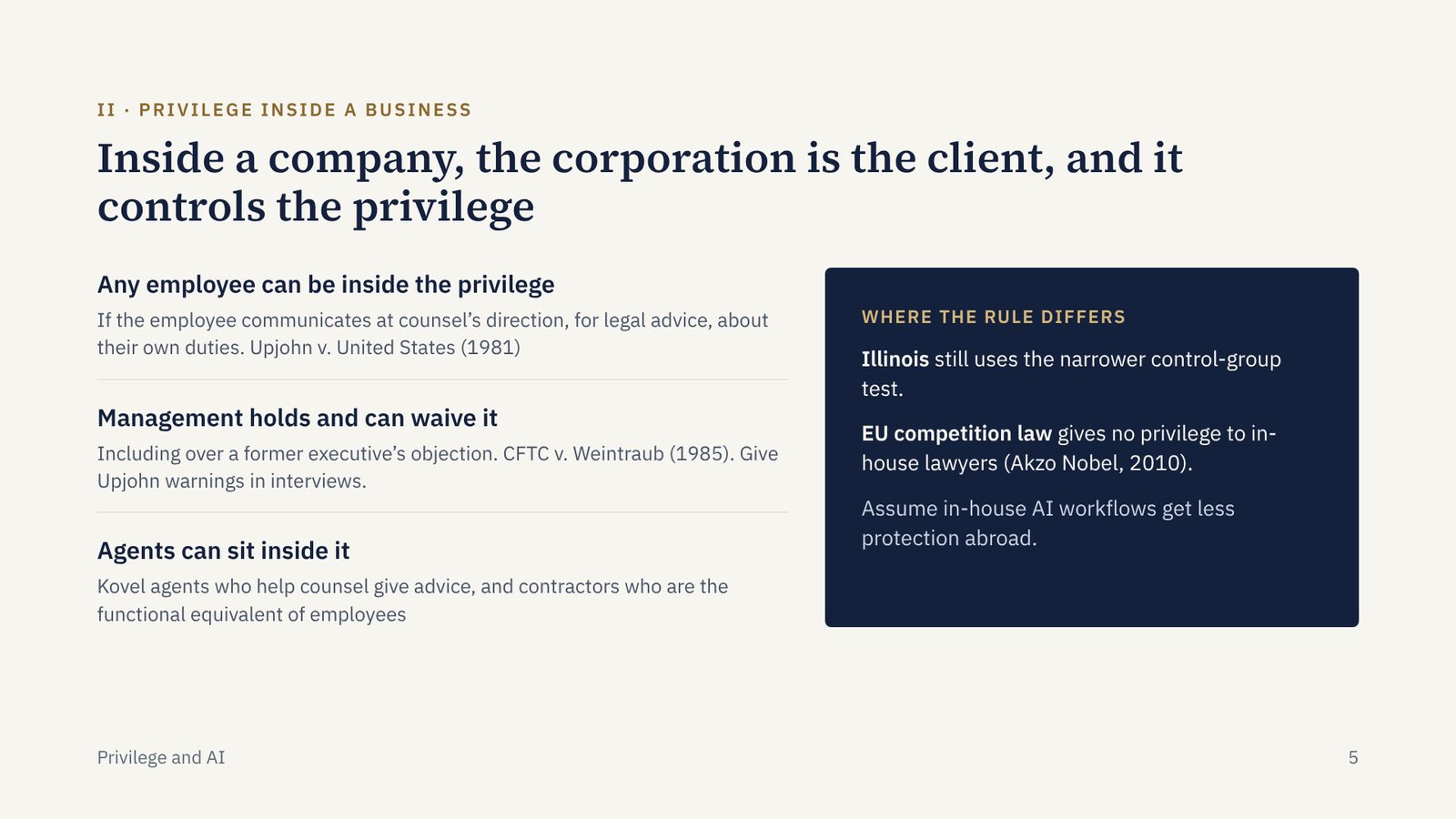
The corporation is the client. In-house communications are privileged only when they are confidential, kept to people who need them, and made primarily for legal advice rather than business advice. In-house lawyers carry a heavier burden than outside counsel because they often give both kinds of advice.
A. The corporate client: Upjohn
Upjohn Co. v. United States, 449 U.S. 383 (1981), rejected the "control group" test in federal courts. Communications from employees at any level are privileged when they are made at counsel's direction, to get legal advice for the company, and about matters within the employee's duties, and the employee knows the purpose. Id. at 394–97.
- The privilege belongs to the company. Management can waive it, including over a former executive's objection. CFTC v. Weintraub, 471 U.S. 343, 348–49 (1985).
- Upjohn warnings. In interviews, counsel should tell employees that counsel represents the company, not them, and that the company may waive the privilege. These warnings protect the company's control of the privilege.
- State law varies. In state-law matters, a few states still apply narrower tests; Illinois, for example, uses the control-group test. Consolidation Coal Co. v. Bucyrus-Erie Co., 432 N.E.2d 250, 257 (Ill. 1982).
- Outside the U.S. EU competition law doesn't protect communications with in-house lawyers. Akzo Nobel Chemicals Ltd v. Commission, Case C-550/07 P (CJEU 2010). Multinationals should assume that in-house AI workflows may get less protection abroad.
B. Dual-purpose communications and the primary-purpose test
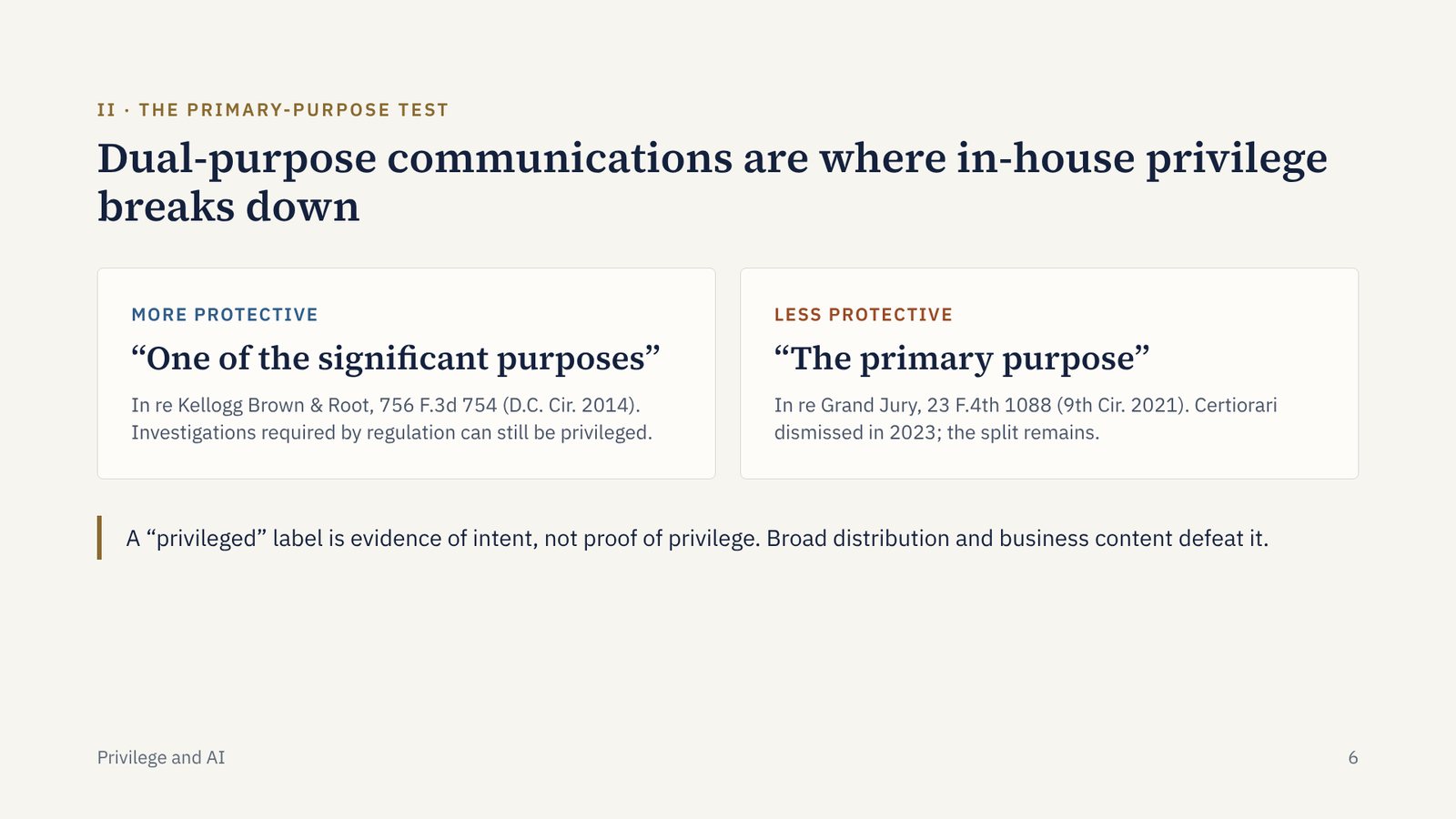
The hardest in-house question is a communication that mixes legal and business advice. Federal courts apply some form of a primary-purpose test, but they phrase it differently.
- In re Kellogg Brown & Root, Inc., 756 F.3d 754, 758–60 (D.C. Cir. 2014) (Kavanaugh, J.): privilege applies if getting or giving legal advice was "one of the significant purposes" of the communication. An internal investigation required by regulation or company policy can still be privileged.
- In re Grand Jury, 23 F.4th 1088, 1091–95 (9th Cir. 2021): the court applied a stricter "the primary purpose" test to dual-purpose communications and declined to decide whether Kellogg applies outside that case. The Supreme Court granted certiorari and then dismissed it as improvidently granted, 598 U.S. 15 (2023). The circuits remain split.
- Practical result. Communications labeled "privileged" that circulate business strategy, or send legal analysis to a broad distribution list, are often found unprotected. A label is evidence of intent, not proof of privilege.
C. Agents, consultants, and Kovel
Third parties inside the privilege fall into two groups:
- Kovel agents help the lawyer understand information so the lawyer can give legal advice, such as an accountant translating tax data. United States v. Kovel, 296 F.2d 918, 922 (2d Cir. 1961).
- Functional equivalents of employees are contractors so embedded in the company that they act as employees. In re Bieter Co., 16 F.3d 929, 937–39 (8th Cir. 1994); In re Copper Mkt. Antitrust Litig., 200 F.R.D. 213, 219 (S.D.N.Y. 2001).
These doctrines are the most likely route for treating an AI tool as within the privilege. Counsel would retain or direct the tool to help render legal advice, under contractual confidentiality. Heppner signaled the same idea (Part III).
D. Internal investigations and common interest
- Internal investigations led by counsel to give legal advice are privileged under Upjohn and Kellogg. Counsel's interview memoranda are classic opinion work product. Facts uncovered are not privileged, and disclosing investigation findings to regulators usually waives protection. Most circuits reject "selective waiver." See In re Pacific Pictures Corp., 679 F.3d 1121, 1127–29 (9th Cir. 2012).
- Common-interest arrangements let parties with a shared legal interest exchange privileged material without waiver. They are construed narrowly, and some jurisdictions require pending or anticipated litigation. Ambac Assurance Corp. v. Countrywide Home Loans, Inc., 27 N.Y.3d 616, 628 (2016).
E. Why AI raises the stakes in-house
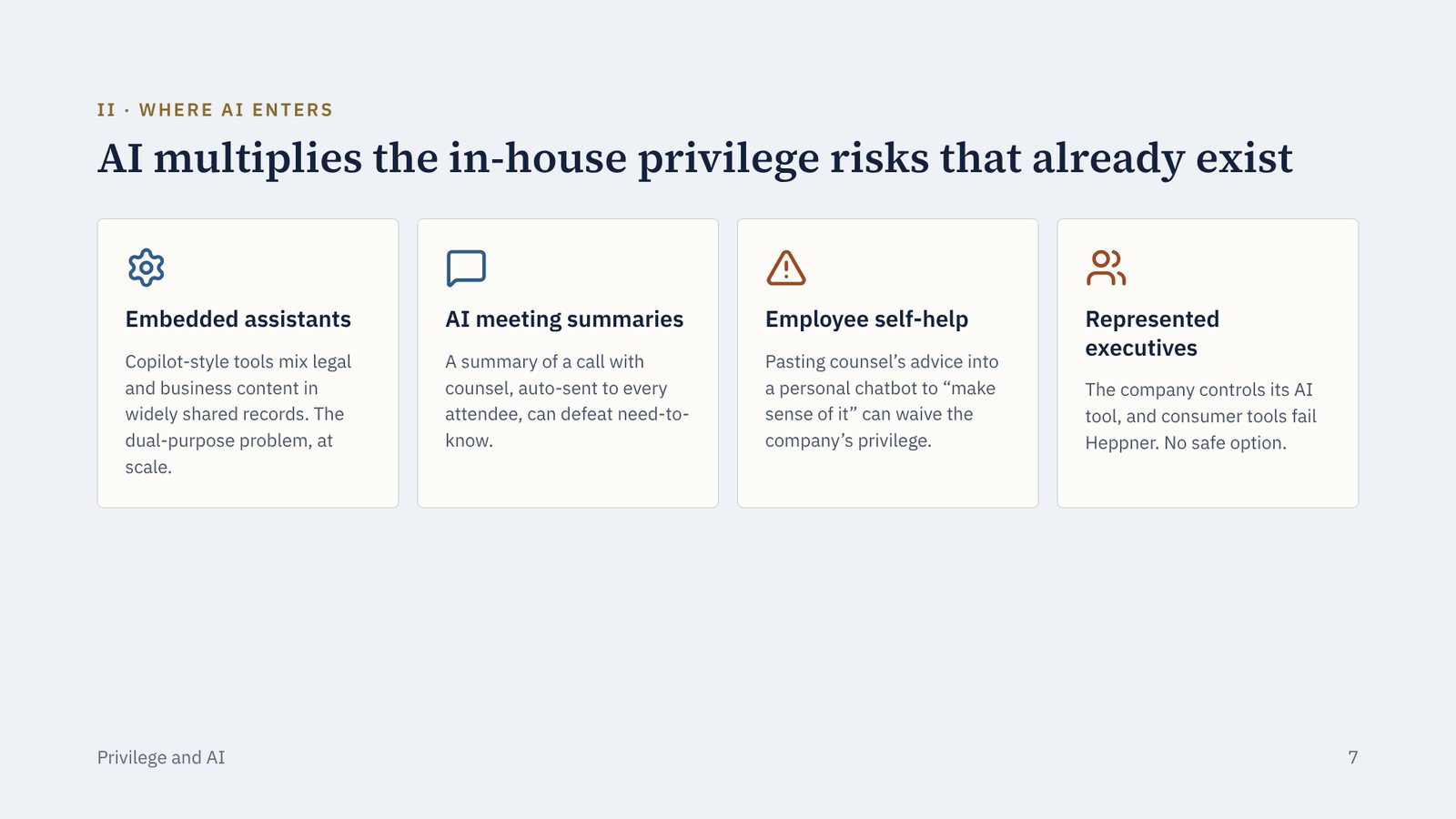
- Enterprise AI is embedded in business workflows. Copilot-style assistants, meeting summarizers, and shared AI workspaces generate records that blend legal and business content and are widely accessible. This is the dual-purpose problem at scale.
- AI meeting summaries can defeat need-to-know. A summary of a call with counsel, automatically sent to every attendee or stored in a shared channel, may be treated as a business record or circulated beyond the privileged group.
- Employee self-help looks like Heppner. An employee who pastes a lawyer's advice into a consumer chatbot to "make sense of it" may waive the company's privilege over that advice.
- AI agents can reach privileged files on their own. An agent authorized for an ordinary business task may search connected repositories, open legal folders, read email, or send information outside the company without a person reviewing each step. California's May 2026 practical guidance on generative AI recommends tight permissions and scrutiny of autonomous access and transmission.
- AI recording and transcription create new records. NYC Bar Formal Opinions 2025-6 (client conversations) and 2026-2 (non-client conversations, such as witnesses) address AI recording, transcription, and summaries. They recommend getting participants' consent and, for non-client conversations, not recording by default.
- Separately represented executives have no safe AI option. In investigations, officers and directors often have their own counsel. An executive can't safely use the company's AI tool to prepare for meetings with personal counsel, because the company controls that data and its privilege. After Heppner, a consumer tool isn't safe either. Fried Frank has also flagged officers' and directors' personal AI accounts used for company legal questions as a discovery risk.
F. What peer companies are doing
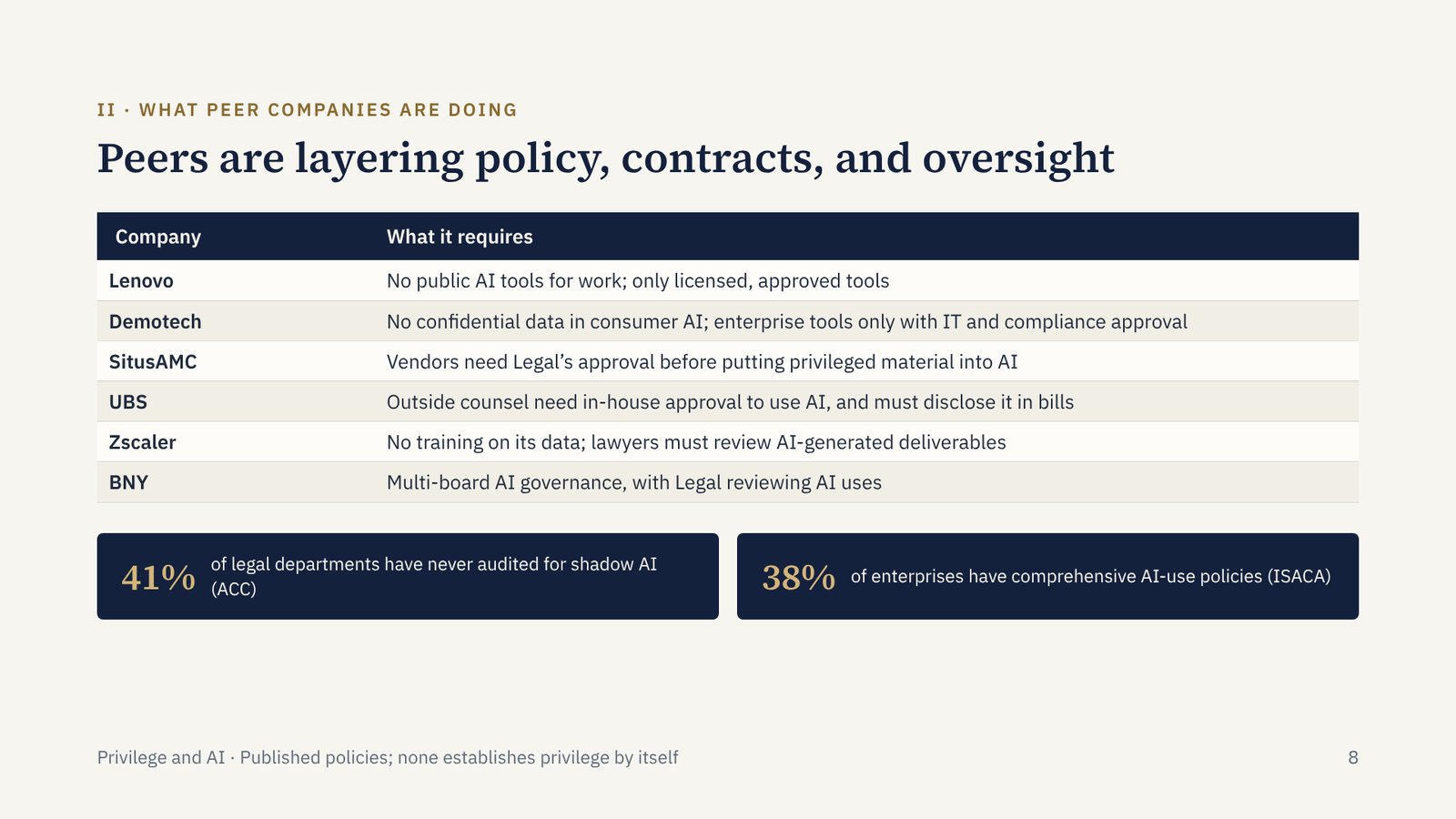
Published corporate policies show a layered approach. None of these policies establishes privilege by itself, but they show what "reasonable steps" look like in practice.
| Company | Practice |
|---|---|
| Lenovo | Bans public generative AI tools for work; only licensed, approved tools |
| Demotech | No confidential information in consumer AI; enterprise tools only if IT and compliance approve |
| CK Infrastructure | Legal research and analysis only by or with the legal department; IT authorization before privileged information goes into AI |
| SitusAMC | Vendors may not put privileged information or work product into AI without Legal's approval |
| UBS | Outside counsel need in-house approval before using AI on UBS matters, and must disclose it in billing |
| Zscaler | No training on Zscaler data; lawyer review required for AI-generated deliverables |
| BNY | Multi-board AI governance (data-use review, AI release board, Enterprise AI Council) with Legal participating |
Adoption is outpacing governance. An ISACA study found only 38% of enterprises have comprehensive AI acceptable-use policies. An Association of Corporate Counsel survey found 85% of in-house legal departments now use AI, but 41% have never audited for unapproved "shadow AI" and don't plan to.
III. Is AI Use Privileged?
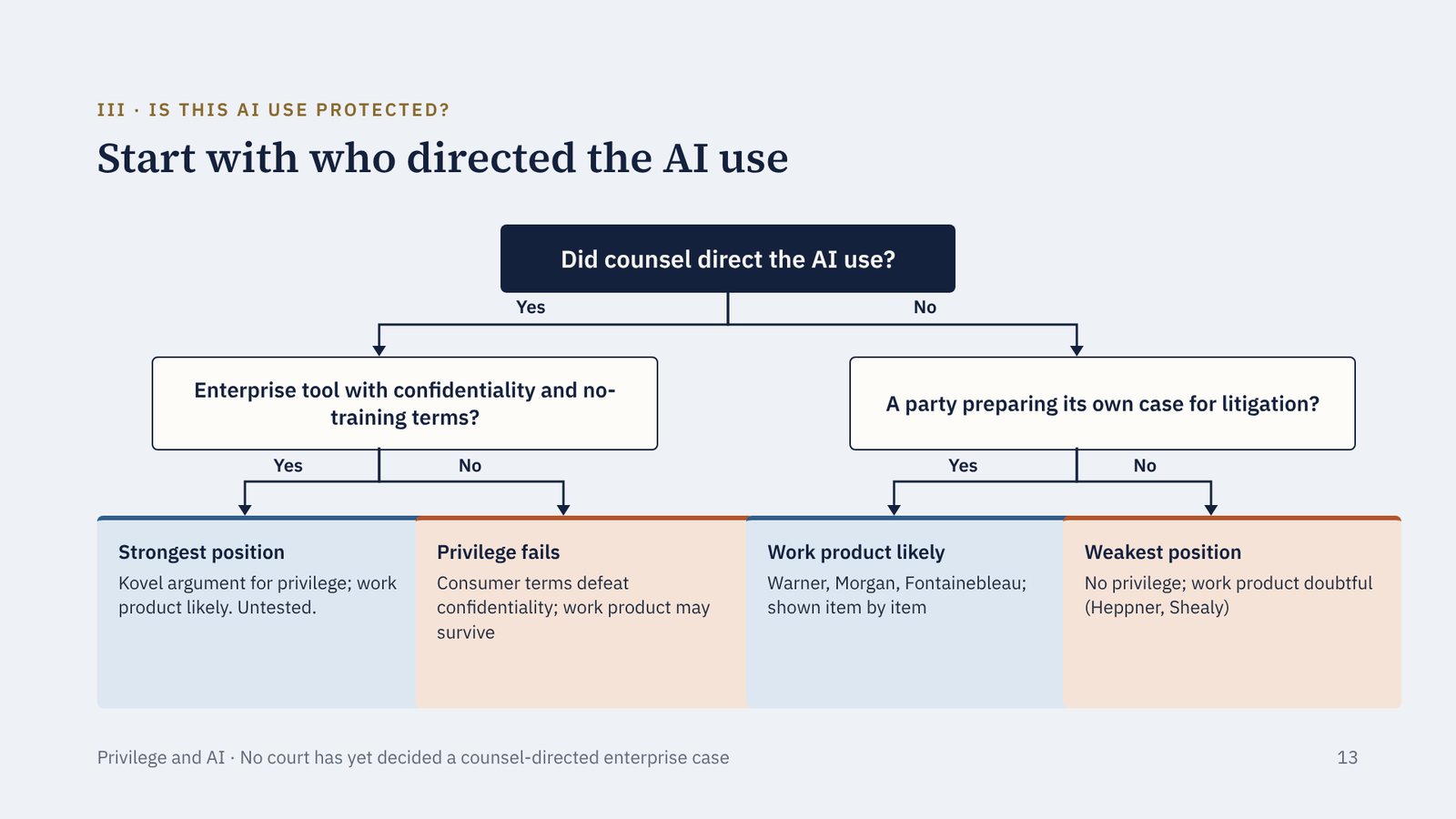
No court has recognized an "AI privilege." Courts apply existing doctrine, which yields two consistent rules so far. A client's self-directed use of a consumer AI tool is not attorney-client privileged. Litigation-preparation use of AI is often protected work product, because an AI provider is not an adversary. The law is less than a year old, comes only from trial-level courts, and is not uniform. Of eight rulings to date, six protected the AI materials.
A. The leading decision: United States v. Heppner
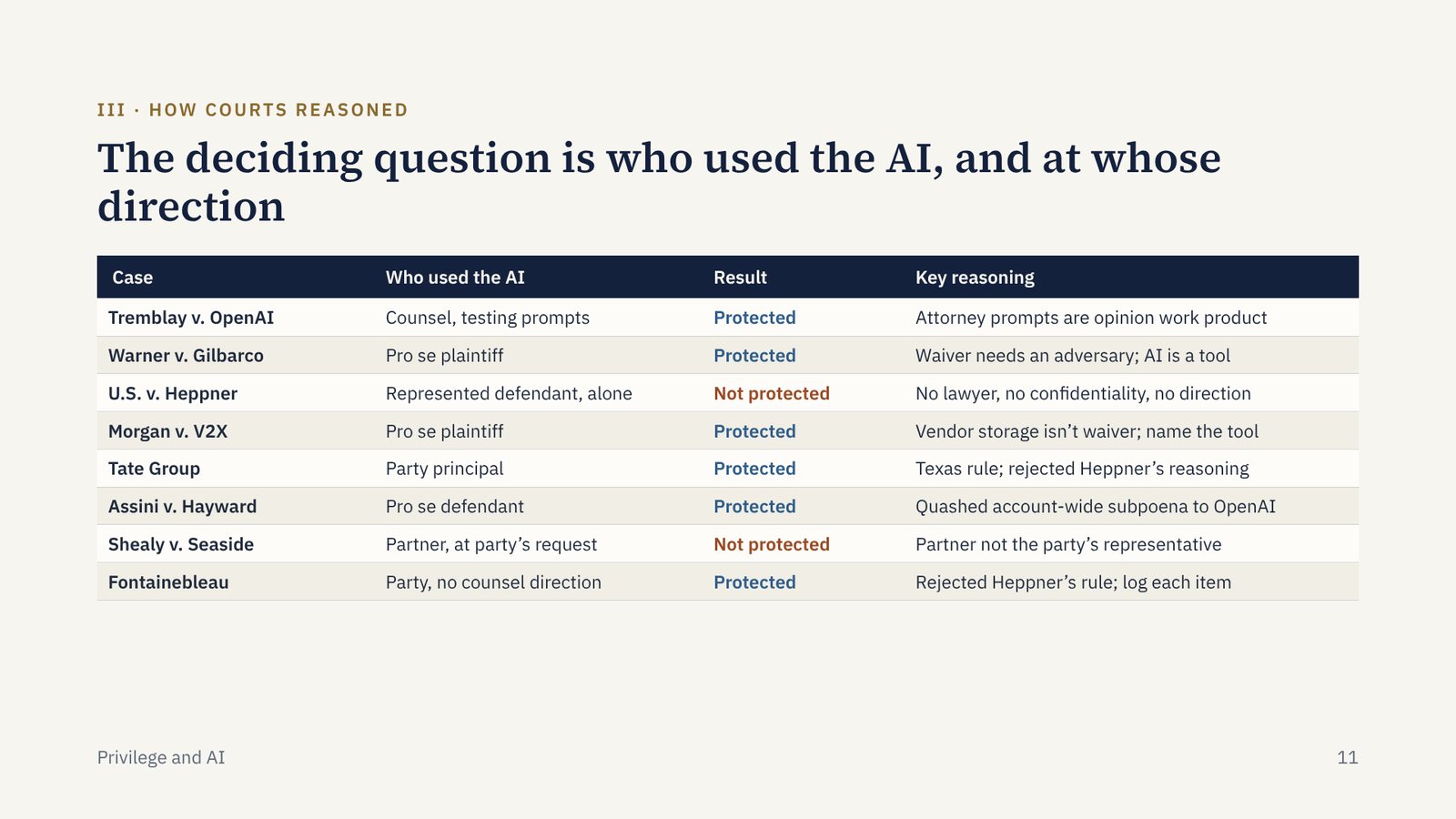
United States v. Heppner, No. 25 Cr. 503 (JSR), 820 F. Supp. 3d 292 (S.D.N.Y. Feb. 17, 2026) (Proskauer summary; Cleary summary). After receiving a grand jury subpoena and retaining counsel, a securities-fraud target used the consumer version of Claude to outline defense strategies. Agents seized about 31 of these AI documents. Counsel conceded they had not directed the AI use. Judge Rakoff ruled from the bench on February 10 and issued a written opinion on February 17.
- Not a communication with a lawyer. Claude is not an attorney, and two non-lawyers discussing legal issues is not privileged.
- Not confidential. The court relied on the consumer privacy policy, which allowed collection of inputs and outputs, model training, and disclosure to third parties including government authorities. It also quoted the January 2026 ruling in In re OpenAI that users lack "substantial privacy interests" in chats they voluntarily give to a public AI platform.
- Not for legal advice from a lawyer. The question was whether Heppner sought legal advice from Claude, which disclaims giving it. Later sending the outputs to counsel did not make them privileged retroactively.
- Waiver of underlying privileged material. In a footnote, the court held that privileged information Heppner typed into Claude was waived, "just as if he had shared it with any other third party."
- No work product. The documents weren't prepared at counsel's behest, and they didn't reflect counsel's strategy. At most they "affected" it.
- The opening the court left. Had counsel directed the use, Claude "might arguably" have acted like a professional agent of the lawyer within the privilege, citing Kovel-line authority. That is the doctrinal basis for counsel-directed AI workflows.
B. The work-product line: AI as "a tool, not a person"
- Warner v. Gilbarco, Inc., 820 F. Supp. 3d 629, 636 (E.D. Mich. Feb. 10, 2026) (Patti, M.J.). A pro se employment plaintiff's ChatGPT prompts and outputs were protected work product. Work-product waiver requires disclosure to an adversary, and ChatGPT is a tool, not a person. The court called the request a fishing expedition.
- Morgan v. V2X, Inc., No. 25-cv-01991, 2026 WL 864223 (D. Colo. Mar. 30, 2026) (Dominguez Braswell, M.J.). Rule 26(b)(3) protects a pro se party's AI-assisted work, and storage by a third-party provider doesn't automatically waive protection. But the plaintiff had to identify the AI platform he used with the defendant's confidential material. The court also amended the protective order to restrict confidential discovery to tools with contractual protections, such as no training on inputs, no disclosure to third parties, and deletion on demand.
- Tate Group Automotive, LLC v. Legacy Automotive Capital, LLC, No. 25-BC11B-0020 (Tex. Bus. Ct. June 3, 2026) (Dorfman, J.). A party principal's ChatGPT chats were work product under Tex. R. Civ. P. 192.5, with no waiver. The court rejected Heppner as applying a different standard. It still ordered disclosure of which discovery materials were shared with ChatGPT and urged amending the protective order.
- Assini v. Hayward, 2026 NY Slip Op 26086 (Sup. Ct. Nassau Cnty. June 4, 2026). The court quashed subpoenas to OpenAI for a pro se defendant's prompts, uploads, and outputs. It held that CPLR 3101(d) protects AI-assisted litigation preparation and that using a commercial tool doesn't waive that protection.
- Shealy v. Seaside Investments, LLC, No. 2684CV00799-BLS2, 2026 Mass. Super. LEXIS 135 (Mass. Super. Ct. June 16, 2026). This case goes the other way. At the plaintiff's direction, his partner used AI to help draft a response to a creditor's default notice, without counsel's involvement. The court refused to treat the partner as the plaintiff's "representative," reasoning that doing so would expand work product without meaningful limits, and ordered the materials produced. Commentators have criticized the ruling because Rule 26(b)(3) covers materials prepared "by or for" a party, and the partner appears to have acted for the plaintiff.
- Fontainebleau Florida Hotel, LLC v. Botach (S.D. Fla. Oct. 21, 2026) (Elfenbein, M.J.). In a defamation case, the plaintiff sought the defendant's AI chats as evidence of intent and motive, and subpoenaed the four AI providers he used. The court held that work product can cover AI prompts and outputs even when counsel didn't direct the use, declining to follow Heppner to the extent it requires counsel's direction. But it rejected a blanket objection: protection must be shown document by document on a privilege log. Because a provider could produce chats straight to opposing counsel, the court ordered the parties to agree on a production process that lets the defendant assert work product first.
- Tremblay v. OpenAI, Inc., No. 23-cv-03223-AMO, 2024 WL 3748003 (N.D. Cal. Aug. 8, 2024). Before 2026, the court held that attorney-crafted prompts, account data, and test results were opinion work product, and that putting some outputs in the complaint didn't waive the rest.
C. How the decisions fit together
| Factor | Weighs toward protection | Weighs against protection |
|---|---|---|
| Who directed the AI use | Counsel directed it, or a party preparing their own case (Fontainebleau goes furthest) | A represented client or a third party acting without counsel (Heppner, Shealy) |
| Tool and terms | Enterprise tool; no training; confidentiality, no-disclosure, and deletion terms (satisfies confidentiality only) | Consumer tool whose policy permits training, human review, or disclosure to authorities |
| Purpose and timing | Prepared because of pending or anticipated litigation | Ordinary business use; general research; self-help legal advice |
| Doctrine invoked | Work product (waived only through an adversary) | Attorney-client privilege (waived by any third-party disclosure) |
| Content | Reflects counsel's or the party's mental impressions and strategy | Facts, or privileged advice pasted into the tool |
| Record | Document-by-document privilege log stating the basis and the expectation of confidentiality | Blanket objections over a whole AI account |
Enterprise terms are necessary but not sufficient. Heppner turned partly on the consumer privacy policy, so an enterprise tool with no-training and confidentiality terms likely satisfies the confidentiality element. Commentators have noted that it doesn't cure the other two failures Heppner found: an AI isn't an attorney, and a tool that disclaims giving legal advice can't be the source of legal advice. Those elements come from counsel's direction. No court has yet decided a case involving counsel-directed use of an enterprise tool.
D. Related authority and guidance
- Discoverability is a separate question. Even unprivileged AI logs must be relevant and proportional. Courts quash broad, account-wide demands (Assini). But testifying experts' AI prompts may be discoverable as methodology. Conservation Law Found. v. Shell Oil Co., No. 3:21-cv-00933 (D. Conn. May 18, 2026) (order stayed pending objection).
- Courts are policing AI use through protective orders (Morgan; Jeffries v. Harcros Chemicals). Expect AI clauses to become standard in protective orders.
- Ethics. ABA Formal Opinion 512 (July 29, 2024) requires lawyers using generative AI to understand how a tool uses and stores inputs. Under Model Rule 1.6, they must get informed client consent before putting confidential information into self-learning tools that could disclose it. Rules 1.1, 5.1, and 5.3 add competence and supervision duties.
- Legislation. Arizona HB 2410 (2026) would have made communications with an AI privileged whenever the same advice from a human professional would be. It passed the House and stalled in the Senate. No U.S. jurisdiction has enacted an AI privilege.
- Abroad. The UK Upper Tribunal observed that uploading confidential documents to a public AI tool breached client confidentiality and risked waiving privilege. UK v. Secretary of State for the Home Department [2026] UKUT 81.
IV. Ephemeral Chats and Deleting AI Chats
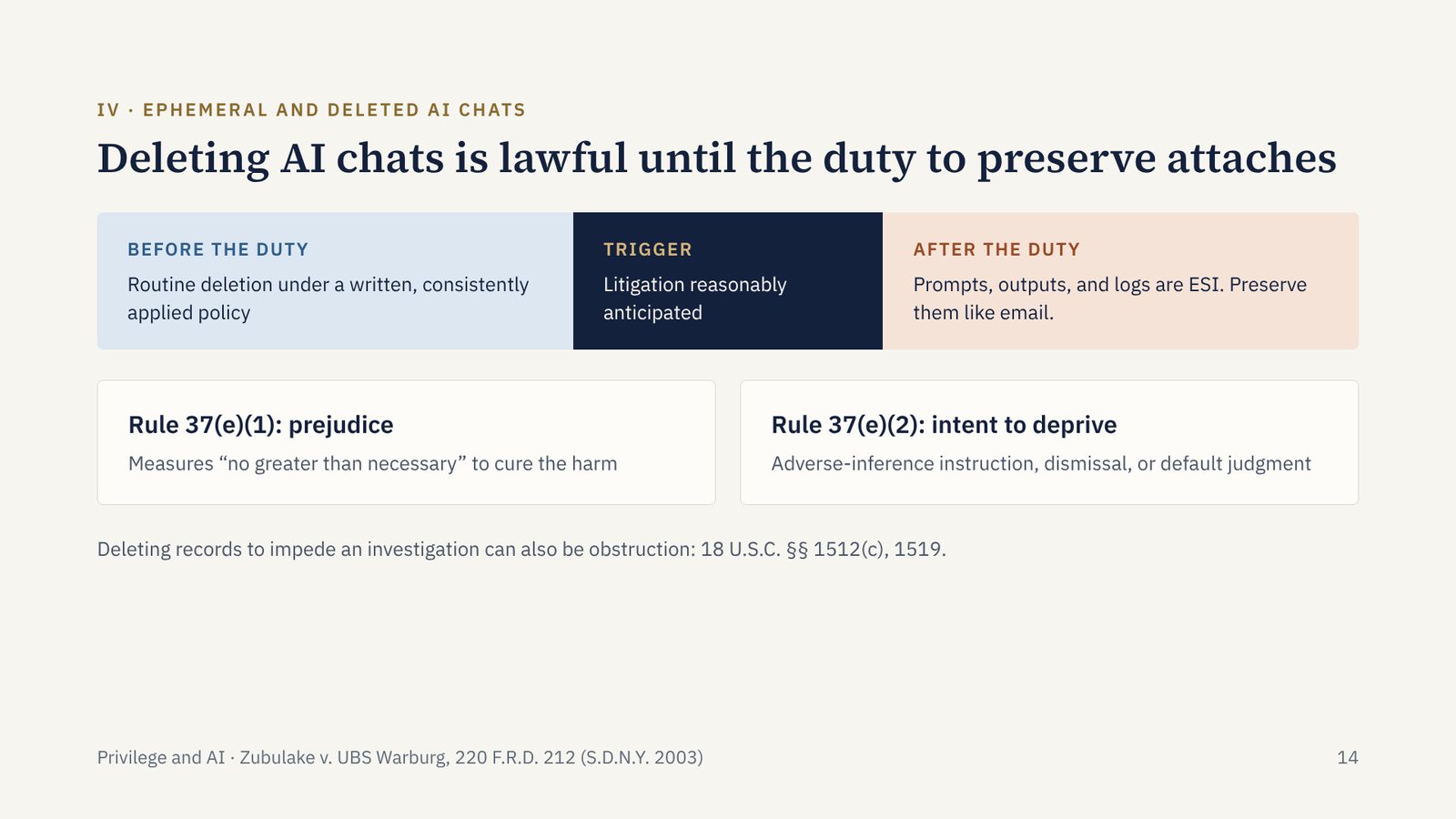
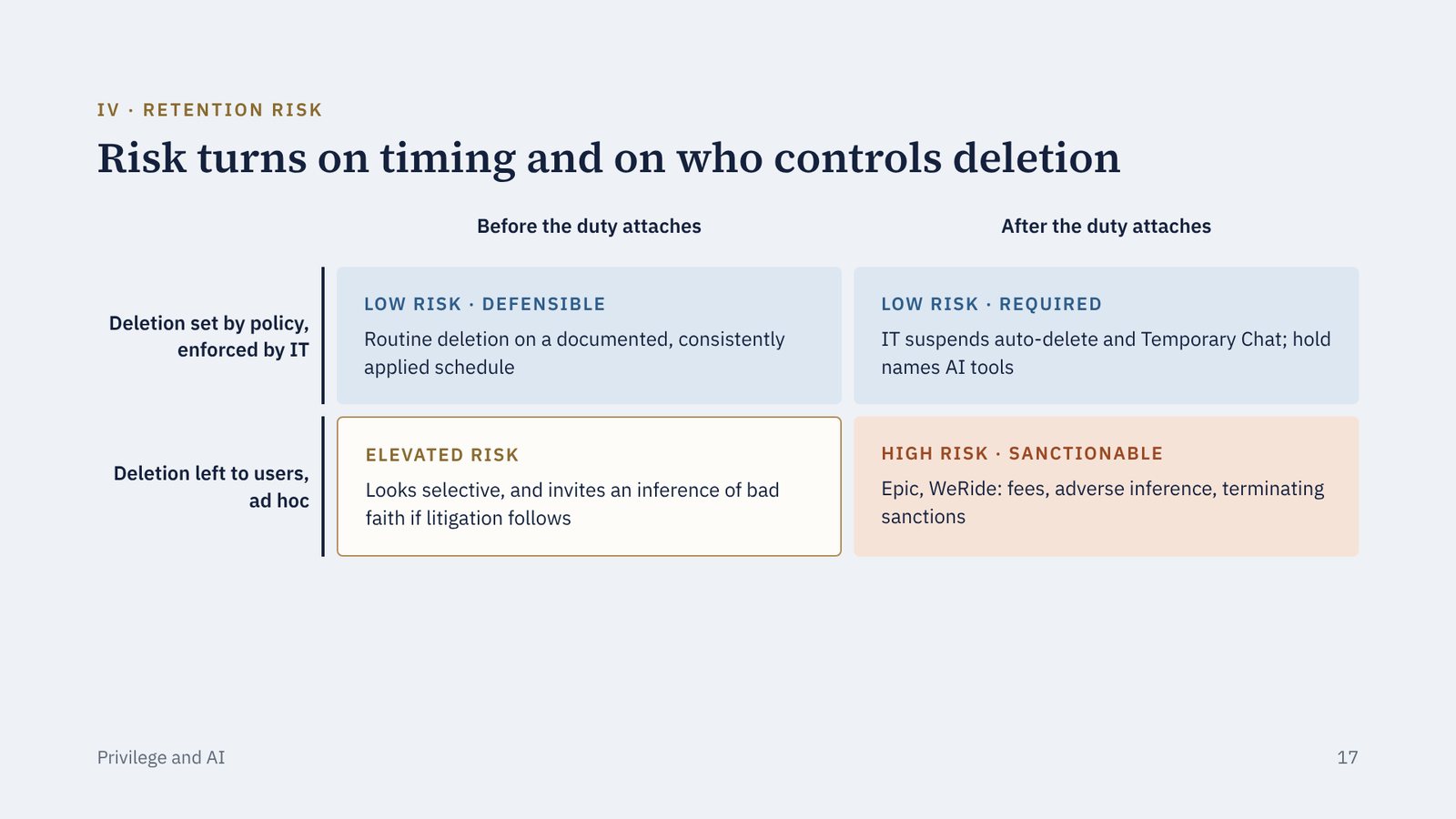
Deleting AI chats is lawful before a preservation duty attaches and risky after it. Once litigation is reasonably anticipated, AI prompts, outputs, and logs are ESI that must be preserved like email. Courts have also shown that "deleted" is not final when a vendor holds the data.
A. The duty to preserve and Rule 37(e)
- Trigger. The duty attaches when litigation is pending or reasonably anticipated, and it covers relevant ESI held by key custodians. Zubulake v. UBS Warburg LLC, 220 F.R.D. 212, 216–18 (S.D.N.Y. 2003). Routine deletion under a reasonable retention policy before that point is generally permissible.
- Rule 37(e) governs lost ESI that should have been preserved, was lost because a party didn't take reasonable steps, and can't be restored or replaced.
- (e)(1): if the loss prejudices the other side, the court may order measures "no greater than necessary to cure the prejudice."
- (e)(2): only on a finding of intent to deprive may the court presume the lost information was unfavorable, give an adverse-inference instruction, or dismiss the case or enter default.
- Not just civil exposure. Deleting records to impede an investigation can be obstruction of justice (18 U.S.C. §§ 1512(c), 1519).
- Records schedules don't control. Once a hold applies, it covers all potentially relevant information, whether or not the company's retention schedule treats AI content as a "record."
B. Ephemeral-messaging precedent
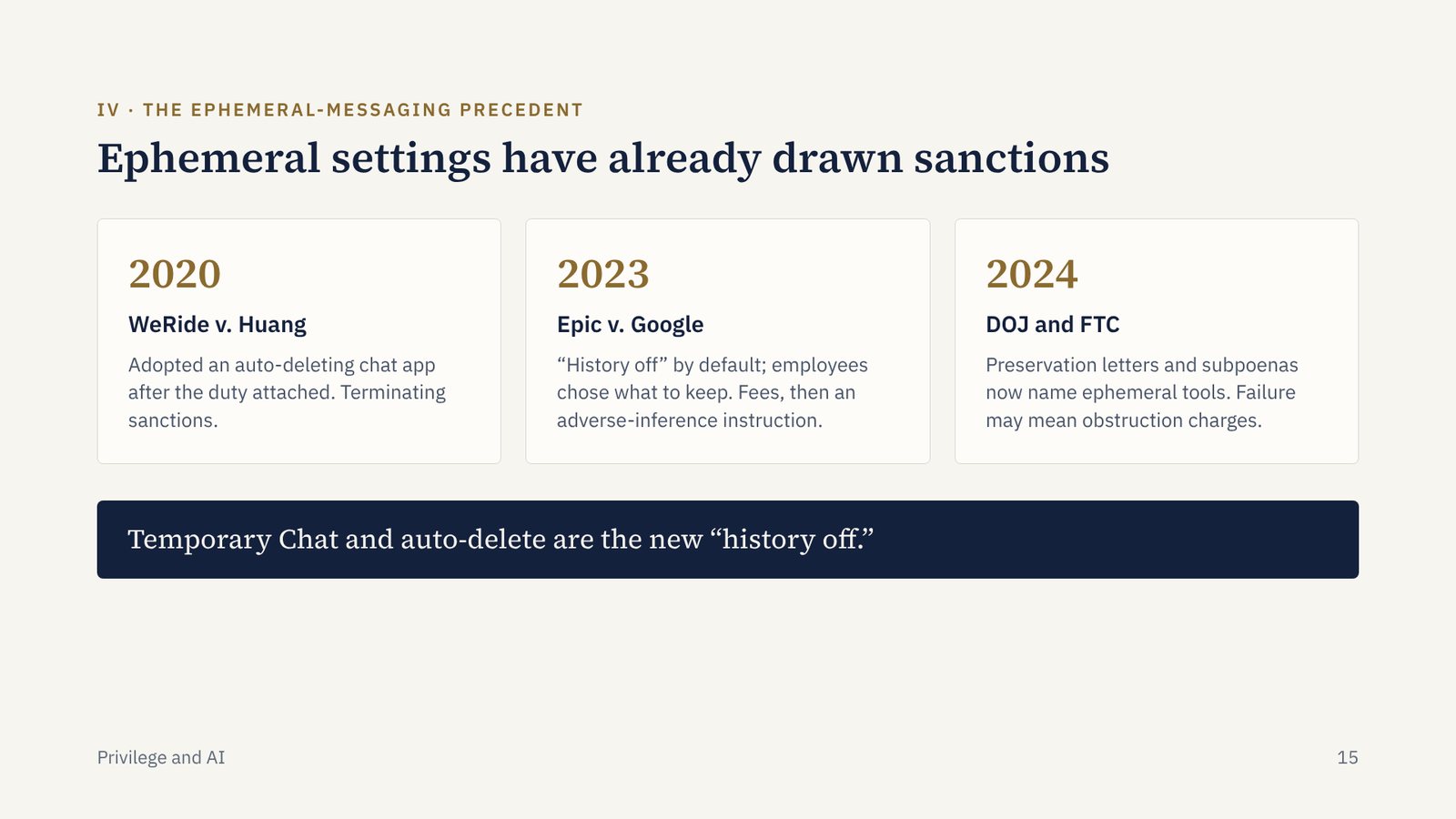
- Epic Games, Inc. v. Google LLC (N.D. Cal. Mar. 28, 2023) (Donato, J.). Google left internal chat "history off" by default, which deleted one-on-one chats after 24 hours, and let employees under legal hold decide what to preserve. The court found sanctionable spoliation and awarded fees. At trial in December 2023, it gave the jury an instruction allowing it to infer the lost chats would have hurt Google. Lesson: a hold that relies on employees choosing to preserve is not reasonable when the company can change the default.
- United States v. Google LLC (D.D.C. Aug. 5, 2024) (Mehta, J.). The court declined sanctions but sharply criticized the same chat practices.
- WeRide Corp. v. Huang, 2020 WL 1967209 (N.D. Cal. Apr. 24, 2020). The court entered terminating sanctions after a defendant adopted an auto-deleting messaging app after the duty to preserve attached.
- Government expectations. DOJ's Criminal Division evaluates whether a company's compliance program governs ephemeral and personal messaging apps (Evaluation of Corporate Compliance Programs, updated Mar. 2023 and Sept. 2024). The DOJ Antitrust Division and FTC updated their preservation letters and subpoenas to cover collaboration tools and ephemeral messaging. They warned that failing to produce such material may lead to obstruction charges (joint statement, Jan. 26, 2024). The Sedona Conference's Commentary on Ephemeral Messaging (2021) recognizes legitimate business reasons for ephemeral tools, provided the policy is documented and suspended for holds.
C. AI-specific preservation: In re OpenAI and beyond
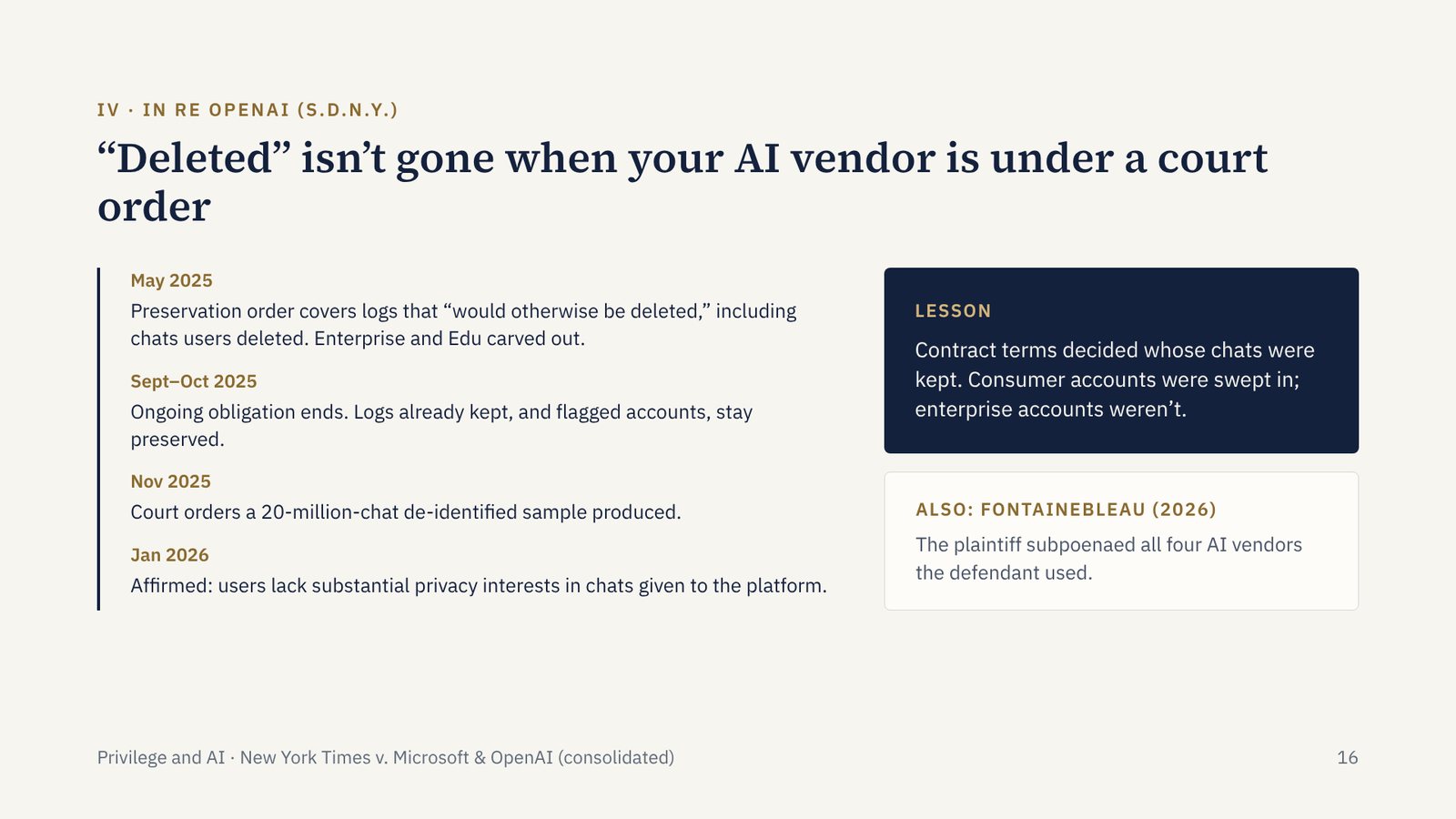
- May 13, 2025. In the consolidated copyright cases led by The New York Times v. Microsoft & OpenAI (S.D.N.Y.), Magistrate Judge Wang ordered OpenAI to preserve and segregate output logs that "would otherwise be deleted." The order expressly covered chats users deleted and chats deletable under privacy laws. District Judge Stein declined to overturn it. ChatGPT Enterprise, Edu, and zero-retention API customers were carved out (OpenAI update).
- Sept. 26 / Oct. 9, 2025. By stipulated order, the ongoing preservation obligation ended. Logs already preserved, and logs for accounts the plaintiffs flagged, remained available.
- Nov. 7, 2025 → Jan. 2026. The court ordered production of a 20-million-conversation de-identified sample of consumer logs and denied reconsideration. In January 2026, Judge Stein affirmed, observing that users lack substantial privacy interests in chats voluntarily disclosed to the platform.
- Fortis Advisors, LLC v. Krafton, Inc., 354 A.3d 906 (Del. Ch. 2026). A CEO's ChatGPT queries became trial evidence of motive and pretext. Deleted chats and an employee's suggestion to "check" company ChatGPT accounts for incriminating content are spoliation issues still pending in the damages phase.
- Fontainebleau Florida Hotel, LLC v. Botach (S.D. Fla. Oct. 21, 2026). Opponents can subpoena AI providers directly. The plaintiff served subpoenas on all four providers the defendant used, and the court had to set a process so the defendant could claim work product before the providers produced anything.
Takeaways. (1) Your users' deletions may not delete anything if the vendor is under a preservation order in someone else's case. (2) Enterprise contracts with defined retention and no-training terms decide whose data gets swept in. (3) Courts treat AI chats as ordinary ESI, so "Temporary Chat" and auto-delete settings are the new "history off."
D. Building a defensible AI retention policy
| Phase | Defensible practice | Practice courts punish |
|---|---|---|
| Ordinary course (no duty yet) | Written, consistently applied retention period for AI logs, set by business and legal need and documented in the records schedule | Ad hoc deletion; retention periods chosen to avoid discovery; "don't put that in writing, ask the AI" culture |
| Litigation reasonably anticipated | Hold notice that names AI tools; IT suspends auto-deletion and Temporary Chat for custodians; vendor exports or holds in place | Relying on custodians to save their own chats; leaving defaults on |
| Investigation or subpoena | Preserve enterprise AI logs, custom instructions, projects, and uploaded files; ask about personal and shadow AI accounts | Employees "cleaning up" AI histories; switching tools mid-matter |
| After the hold is released | Documented release; resume the normal schedule | Undocumented purges near the end of a matter |
E. When privileged material has already leaked
Telling an employee to "just delete it" isn't enough, and may collide with a preservation duty. A defensible response:
- The employee notifies Legal and Information Security right away.
- Identify what was shared, which AI service and account, and the provider's confidentiality and retention terms.
- Find out whether the material was shared further, saved, or used in other chats.
- Before deleting anything, check whether a legal hold or reasonably anticipated litigation requires preserving it. Then use available deletion or access-restriction options.
- Counsel assesses the privilege consequences and documents the reasonable steps taken, which matters under Fed. R. Evid. 502(b) if the disclosure is later litigated.
V. Vetting AI Tools: Contracts and Technical Controls
A tool is only as protective as its actual contract and configuration. Read the governing agreement for the specific service, and test whether your technical controls actually stop sensitive material from leaving.
A. Contract terms that matter
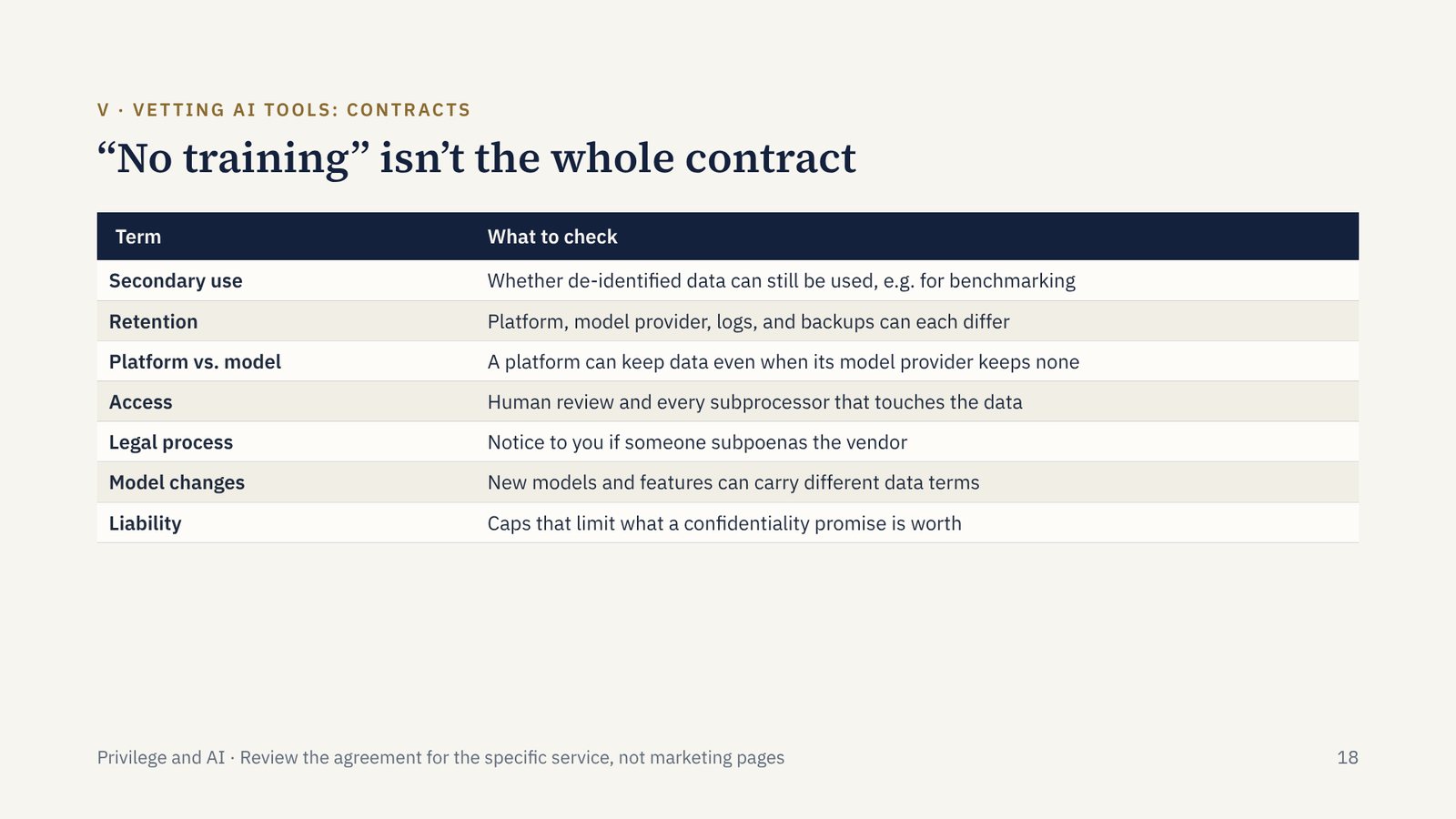
A promise not to train on customer data doesn't mean the vendor won't keep it, let staff see it, or use de-identified versions for benchmarking. Published terms also aren't the same as a negotiated enterprise order form.
| Term | What to check |
|---|---|
| Training and secondary use | Whether "no training" still allows aggregated or de-identified uses, such as benchmarking (GC AI's self-service terms are an example) |
| Retention and logging | Retention can differ across the platform, the underlying model provider, abuse-monitoring logs, and backups |
| Platform vs. model provider | A legal AI platform can keep your prompts even when its model provider keeps nothing. Thomson Reuters says CoCounsel uses zero-retention calls to model providers but retains data under customer settings |
| Human and subprocessor access | How many providers touch the data, and whether staff can review it |
| Legal process | Notice to you and cooperation if someone subpoenas the vendor (see Fontainebleau) |
| Model and feature changes | New models can carry different data terms. Harvey's optional models, for example, have their own retention arrangements |
| Liability and remedies | Liability caps limit what a confidentiality promise is worth |
| Holds and deletion | Automatic deletion must yield to preservation when required |
B. Technical controls
Companies are enforcing AI rules with software rather than policy alone:
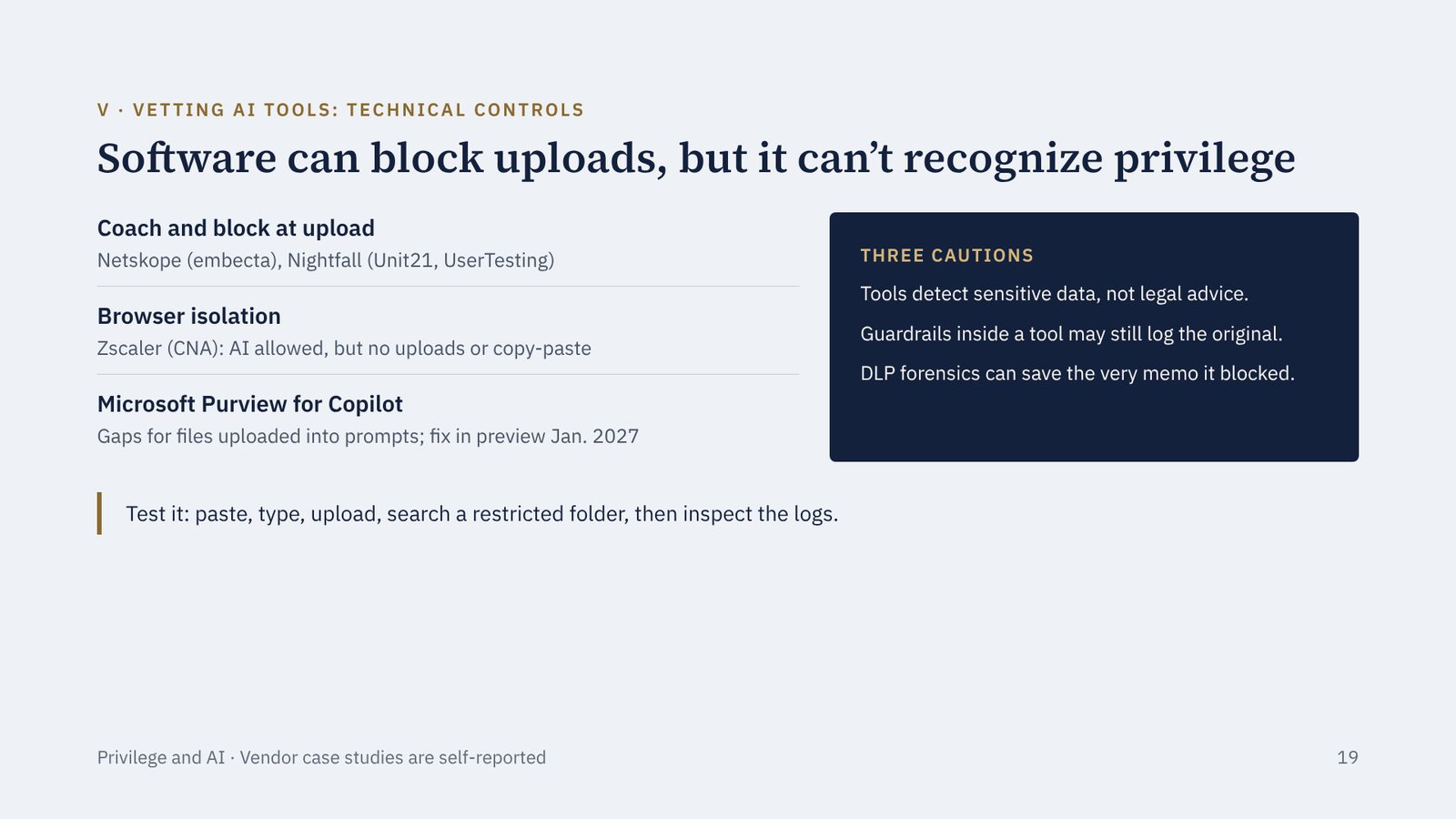
- Coaching and blocking at upload. embecta uses Netskope to ask employees to justify sensitive uploads. Unit21 and UserTesting use Nightfall to catch sensitive content in prompts, screenshots, and files before it reaches tools like ChatGPT, and to redirect employees to approved tools.
- Browser isolation. CNA uses Zscaler to allow AI use in an isolated browser while restricting uploads, downloads, and copy-paste.
- Microsoft 365. Copilot inherits each user's access rights, and Purview data-loss prevention (DLP) can restrict labeled files. But documented gaps remain for files uploaded directly into prompts. Microsoft announced expanded protection on November 17, 2026, with public preview planned for January 2027. Distinguish what's deployed from what's announced.
Three cautions apply:
- These tools detect sensitive data, not privilege. A sentence of legal advice has no tell-tale pattern, and a privileged memo can lose its label when pasted. Pair DLP with repository permissions, approved-workflow rules, and lawyer review.
- Where a control sits matters. Blocking a transfer before it leaves is different from a guardrail inside an approved AI tool, which may still log the original content.
- Security tools create their own copies. DLP forensics (for example, Netskope's) can save the very litigation memo it blocked. Restrict who can see those records and how long they're kept.
C. Test the controls
| Test | What it shows |
|---|---|
| Paste a fake memo marked "Privileged" into an unapproved AI site | Whether browser DLP detects and blocks it |
| Upload a PDF of fictional strategy notes | Whether file inspection and destination rules work |
| Type a sensitive legal question directly into a chatbot | Whether typed prompts, not just pastes, are covered |
| Ask Copilot or an agent to search a restricted legal folder | Whether repository permissions hold |
| Inspect logs after a blocked transfer | Whether the block created a new sensitive copy |
VI. Practical Recommendations
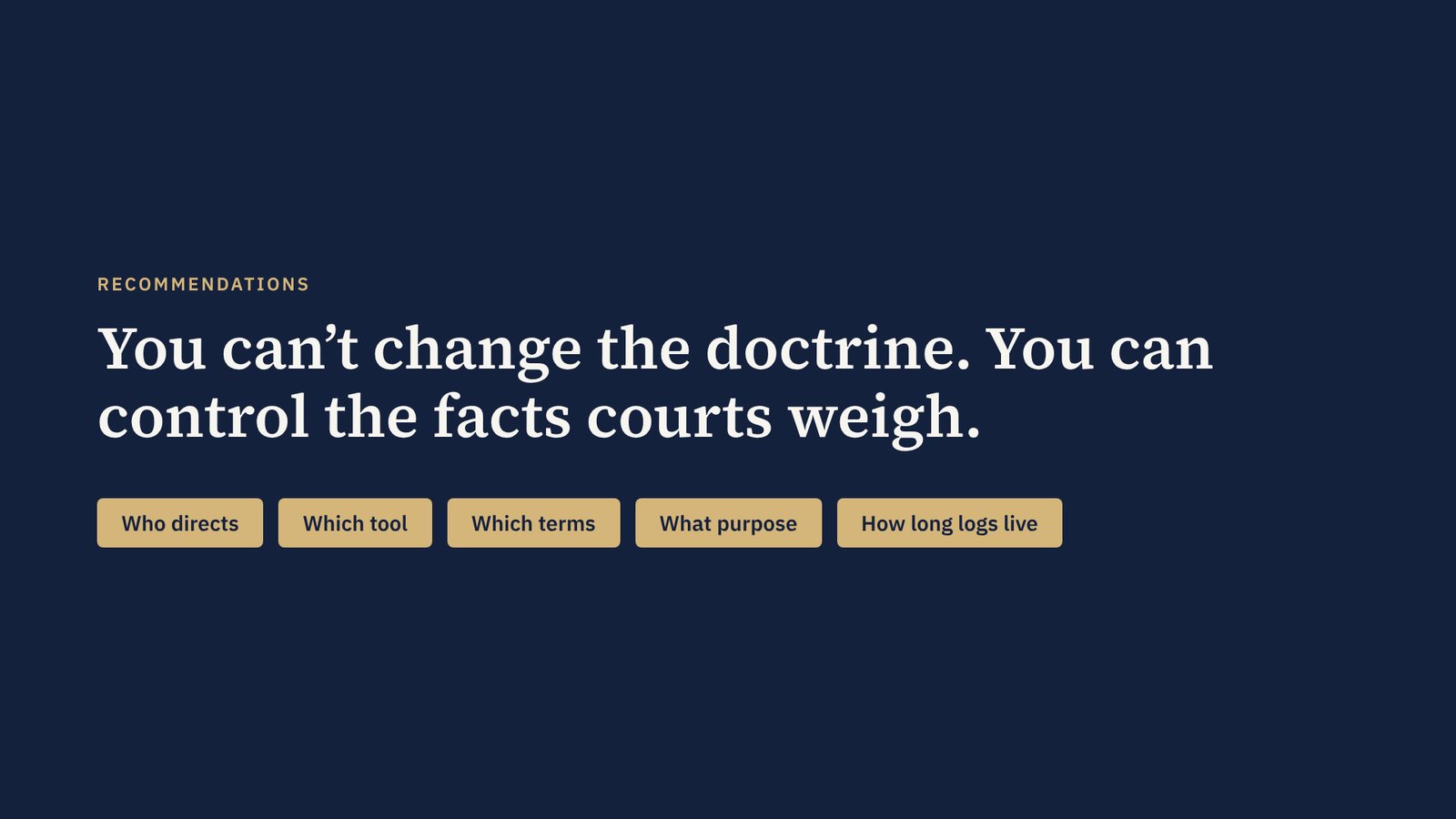
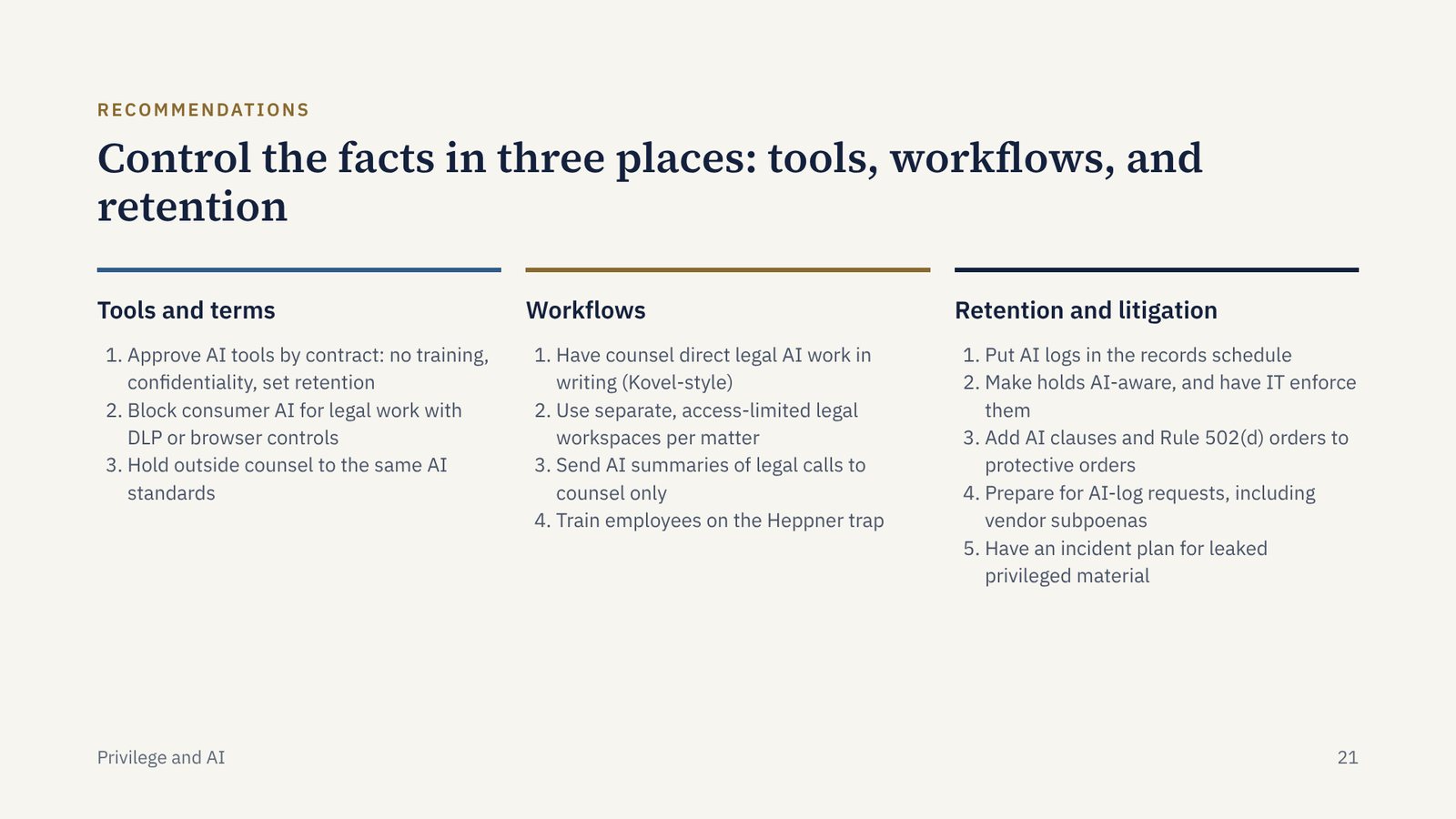
Treat AI governance as privilege governance. The company can't change the doctrine, but it controls the facts courts weigh: who directs the use, which tool is used, under what terms, for what purpose, and how long the logs live.
- Approve tools by contract and configuration, not by brand. Allow only AI tools whose actual terms bar training on inputs, limit human review and secondary use, give notice of legal process, set defined retention and deletion, and impose confidentiality. Check the platform and its underlying model providers separately, and re-review when new models or features are turned on (Part V.A). Keep the executed terms on file, since Heppner and Morgan both turned on them.
- Enforce the rules technically. Block or coach uploads to unapproved AI tools with DLP or browser isolation, restrict AI agents' access to legal repositories, and require human approval before agents send sensitive information outside the company. Test the controls (Part V.C), and lock down the forensic copies they create.
- Put legal AI work under counsel's direction. For privileged matters, have counsel direct the AI use in writing, describing the tool as assisting counsel in rendering legal advice, a Kovel-style arrangement. Note that context in the prompt or matter workspace itself. Keep a separate, access-limited legal workspace for each matter. If you deploy an employee-facing legal Q&A tool, have counsel control it and route summaries to counsel, so it works as counsel's intake channel rather than a chatbot that gives legal advice on its own.
- Keep the primary purpose legal. Separate legal questions from business questions in prompts and outputs. Don't let AI meeting summaries of attorney calls auto-distribute; route them to counsel, label them, and limit access. Get consent before AI recording, and don't record non-client interviews by default.
- Train employees on the Heppner trap. Never paste legal advice, privileged documents, or investigation material into a personal or consumer AI account. Once litigation is anticipated, don't use AI to "prepare" for conversations with counsel unless counsel directs it. Give separately represented executives specific guidance on what tools they may use.
- Extend the rules to outside counsel and vendors. Require approval before outside counsel use AI on company matters (UBS), lawyer review of AI-generated work (Zscaler), and Legal's approval before any vendor puts privileged material into AI (SitusAMC). Require disclosure of which tools touch company data.
- Write AI logs into the retention schedule. Set a retention period for prompts, outputs, uploaded files, custom instructions, agent logs, and DLP incident records. Apply it consistently and document the business reasons. Don't choose periods based on discovery risk.
- Make holds AI-aware. Name AI tools in every hold notice, including embedded assistants such as Microsoft 365 Copilot, Gemini for Workspace, and Slack AI. Have IT suspend auto-deletion and Temporary Chat for custodians instead of relying on custodians to preserve. Ask custodians, including officers and directors, about personal and shadow AI accounts.
- Prepare for AI-log requests, including subpoenas to vendors. Assert work product (and privilege where counsel directed the use) document by document on a privilege log that states the basis and the expectation of confidentiality. Challenge relevance and proportionality and resist account-wide demands (Assini). Negotiate AI clauses and Rule 502(d) orders into protective orders and ESI protocols, including a process for provider subpoenas (Fontainebleau). Be ready to disclose which AI tool was used.
- Have an incident plan for leaks. When privileged material has already gone into an unapproved tool, follow the steps in Part IV.E rather than simply deleting it.
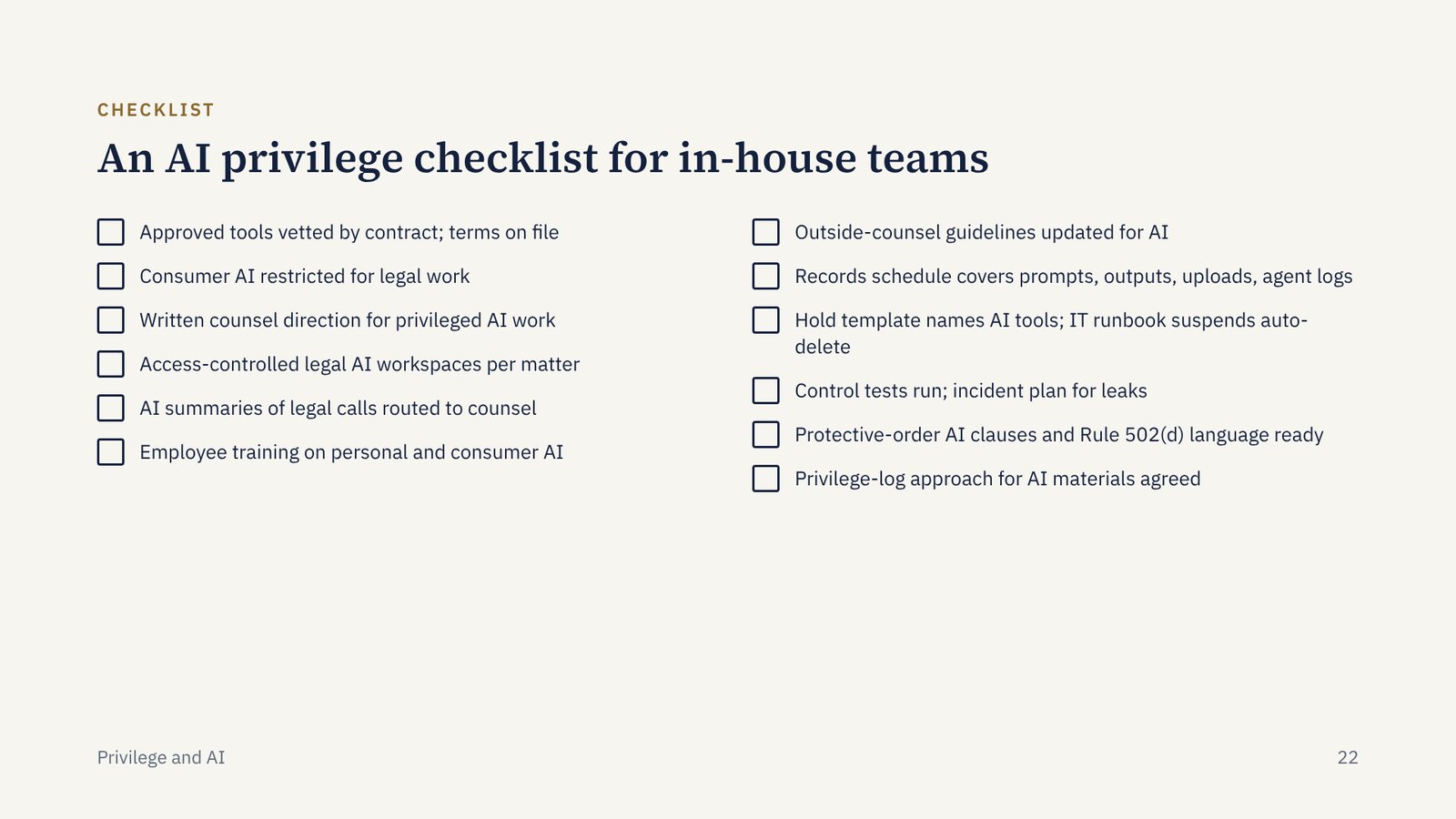
AI Privilege Checklist for In-House Teams
- Approved-tool list based on reviewed contracts and configurations (platform and model provider); executed terms on file
- Consumer AI blocked or restricted for legal and confidential work, enforced by DLP or browser controls
- Control tests run: pasted, typed, and uploaded content; restricted folders; forensic copies
- AI agents limited to approved repositories, with human approval before external transmission
- Written counsel direction for each privileged AI workflow (Kovel-style memo)
- Separate, access-controlled legal AI workspaces for each matter
- AI meeting summaries of legal calls routed to counsel; consent rules for AI recording
- Employee training, including guidance for separately represented executives
- Outside-counsel guidelines and vendor terms updated for AI approval, review, and disclosure
- Records schedule covers prompts, outputs, uploads, agent logs, and DLP incident records
- Hold-notice template names AI tools; IT runbook suspends auto-delete and Temporary Chat
- Vendor contacts, export procedures, and subpoena-notice terms documented for each AI platform
- Protective-order and ESI-protocol AI clauses and Rule 502(d) language ready
- Document-by-document privilege-log approach for AI materials agreed with litigation counsel
- Incident plan for privileged material already shared with an unapproved tool
VII. Developments to Watch
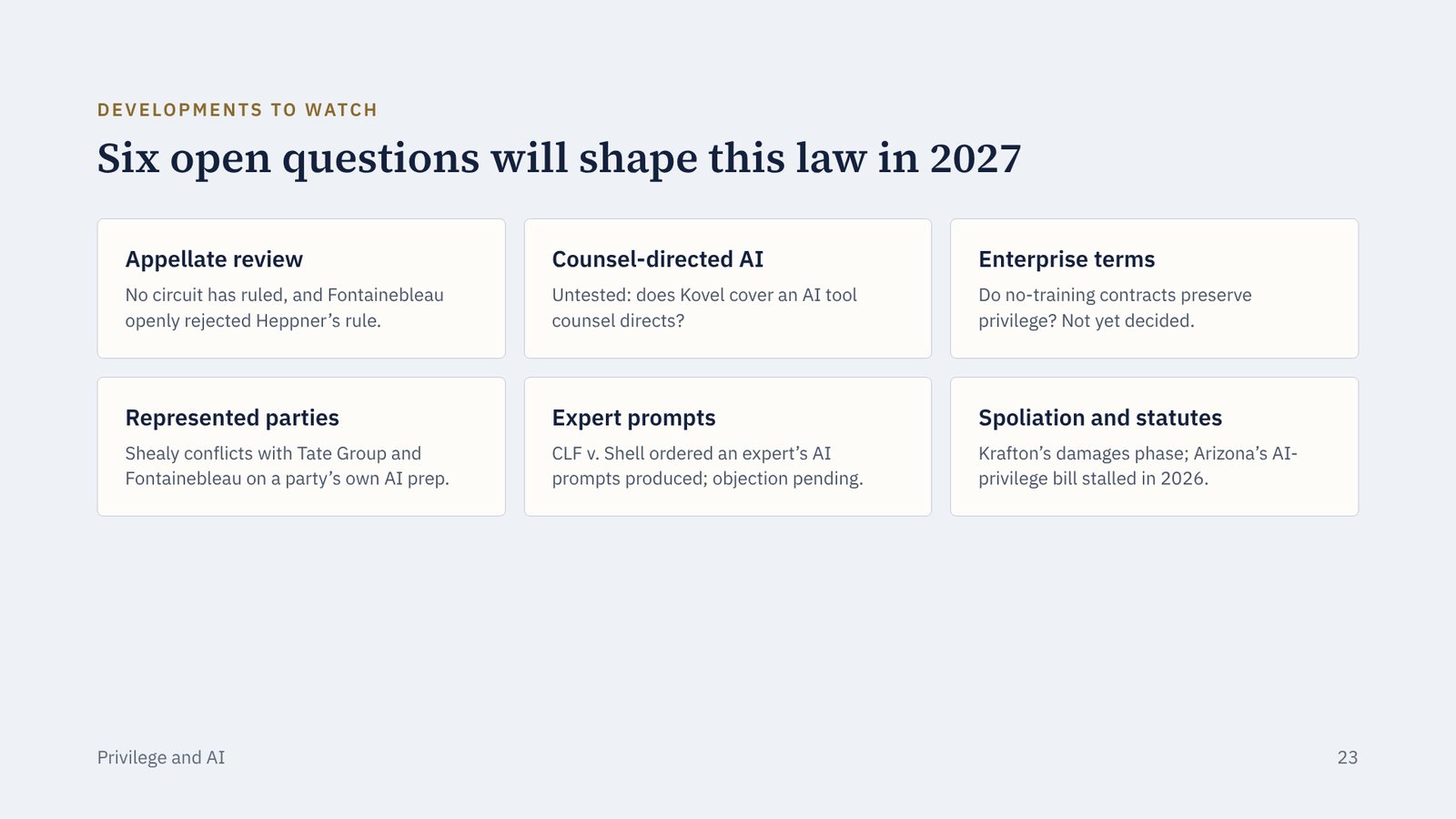
- Appellate review. Every AI-privilege decision so far comes from a trial court or magistrate judge, and they now conflict openly: Fontainebleau declined to follow Heppner. A circuit ruling would reset the landscape.
- Counsel-directed AI under Kovel. No court has yet decided a case where counsel directed the AI use. That is the most important open question for in-house teams.
- Enterprise vs. consumer terms. Courts have relied on consumer privacy policies. None has yet held that enterprise terms preserve attorney-client privilege for non-lawyer use.
- Represented parties' self-directed AI work. Shealy (no protection) conflicts with Tate Group and Fontainebleau (protection).
- Provider subpoenas. Expect more direct subpoenas to AI vendors and more protocols like Fontainebleau's for asserting protection first.
- Expert AI prompts (Conservation Law Found. v. Shell, objection pending) and AI clauses in protective orders.
- AI spoliation sanctions. Krafton's damages phase may produce the first ruling on deleted AI chats.
- Legislation and rules. Watch state AI-privilege bills like Arizona HB 2410, AI-use court rules such as New York's 22 NYCRR Part 161, agentic-AI guidance like California's, and any federal rules committee work on AI evidence.
Sources
- Crowell & Moring, Tracker of Court Rulings on Legal Privilege and AI Tools
- Cleary Gottlieb, Courts Grapple with Privilege Implications of AI (2026)
- Proskauer, SDNY Addresses Privilege and Work Product Implications of Public AI Tools (Feb. 18, 2026)
- Proskauer, Michigan Federal Court Protects AI-Assisted Litigation Work Product (Mar. 2, 2026)
- Morgan v. V2X, Inc., ECF No. 65 (D. Colo. Mar. 30, 2026)
- Spencer Fane, New York and Texas Recognize Work-Product Protection for AI-Assisted Litigation Work
- Nixon Peabody, Lessons from Shealy v. Seaside (July 29, 2026)
- Potomac Law, The CEO's Chatbot History at Trial (Krafton; Tate Group)
- OpenAI, Response to The New York Times' Data Demands (updated Oct. 22, 2025)
- Bloomberg Law, OpenAI Pushes Back on Order to Produce 20 Million ChatGPT Logs
- eDiscovery Today, Google Sanctioned for Google Chat Spoliation (Epic v. Google)
- Wilson Sonsini, DOJ and FTC on Preserving Ephemeral Messages (Jan. 2024)
- Arizona HB 2410 (2026), House Engrossed text
- Herbert Smith Freehills Kramer, US Courts Find Privilege Applies to Self-Represented Litigants' AI Use
- Debevoise, AI Chats May Be Work Product, Even When Lawyers Aren't Involved (Oct. 28, 2026)
- McGuireWoods, Another Court Misses the Mark in AI-Related Work Product Decision (Shealy)
- Heppner memorandum, ECF No. 27 (via Akin Gump)
- California State Bar, Generative AI Practical Guidance (2026)
- NYC Bar Formal Opinion 2025-6 (AI recording of client conversations)
- NYC Bar Formal Opinion 2026-2 (AI recording of non-client conversations)
- Fried Frank, Are AI Legal Chats by Non-Lawyer Officers and Directors Discoverable? (2026)
- Microsoft Purview DLP for Microsoft 365 Copilot
- Netskope Forensics documentation
- Thomson Reuters CoCounsel
- Harvey Platform Agreement
- GC AI Terms
- Internal research memos: Managing AI Risks to Attorney-Client Privilege and Work-Product Protection and Attorney-Client Privilege and AI Research Questions + Answers (Nov. 2026), which collect the corporate policy, vendor case-study, ISACA, and ACC sources cited in Parts II.F and V
Citations to foundational authorities (Upjohn, Hickman, Kovel, Kellogg Brown & Root, In re Grand Jury, Zubulake, Fed. R. Evid. 502, Fed. R. Civ. P. 26(b)(3) and 37(e)) are standard and should be cite-checked before external distribution, along with pin cites throughout.