
Announcement
The AI Lab's New Term: Building an AI Startup and Taking On AI's Privilege Problem
The University of Chicago Law School AI Lab is starting a new term with two big changes. For the first time, students won't just build an AI product. They'll launch a full AI startup. And the Lab is taking on one of the hardest questions in law and technology right now: what happens to privilege when people confide in AI?
Building is the easy part now
AI has made building software dramatically easier. An idea that once took a team of engineers months to create can now be prototyped in a couple of days. Plenty of law students have already built things on their own with AI. That's what we saw in last year's Lab.
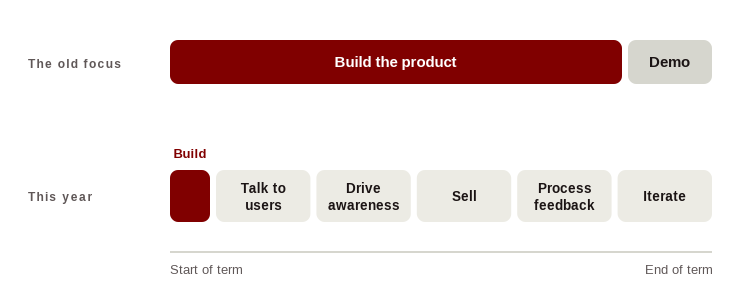
That changes what law schools need to teach. Showing students how to build something isn't enough anymore. The harder and more valuable skill is what comes next: getting people to actually use the tool you build. How do you drive adoption inside your organization? How do you sell to customers? How do you process user feedback and iterate?
This year, the goal isn't to just launch a product. It's to create a startup. Students will build prototypes quickly, then spend most of the term on the hard part: talking to potential users, driving awareness, selling the product, processing feedback, and iterating. If the product gains traction, we will seek funding and turn the project into a business.
"We can build our idea in a couple of days," said Kimball Parker, Head of the AI Lab. "The hardest part comes afterward. Teaching students how to make what they build a success is a major shift for law schools, and it's one of the skills that will matter most."
Privilege wasn't built for AI
Privilege, whether with a lawyer, a doctor, or a therapist, is a person-to-person regime. It depends on a relationship between two people. That's why it maps so poorly onto AI.
When someone chats with an AI assistant, there's no person on the other side. They may be sharing sensitive legal, medical, or emotional details, but that conversation generally isn't protected the way the same conversation with a lawyer, doctor, or therapist would be. Meanwhile, more and more people are turning to AI for legal help, medical help, and emotional support.
This year, the Lab will build an AI platform designed to protect that information, so people can get help from AI without giving up the privilege they would have with a human professional.
"Privilege and AI is one of the trickiest, and most fascinating, problems in law today," Parker said. "People are revealing sensitive information to AI. And we want to build something that protects them when they do."
About the AI Lab
The University of Chicago Law School AI Lab builds AI products each year aimed at making law more accessible. The Lab is led by Kimball Dean Parker, a graduate of the Law School who previously founded LawX, the legal design lab at BYU Law School, and SixFifty, an HR compliance platform acquired by Paychex in 2025.